Holy and Great Thursday


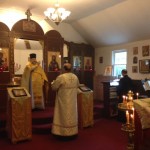
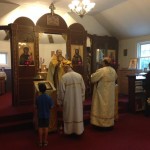
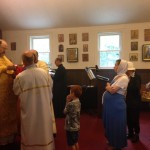
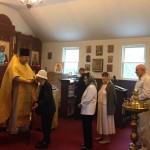
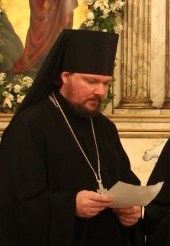
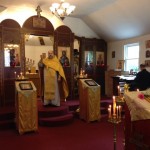
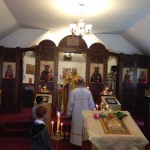
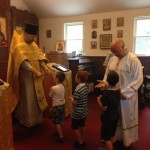
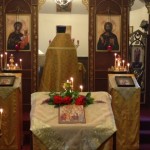
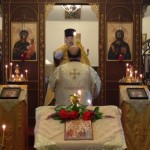
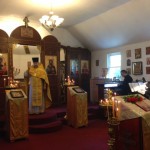
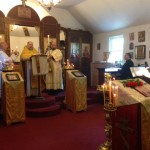
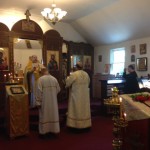
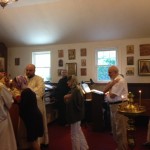
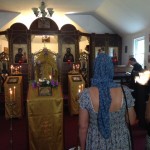
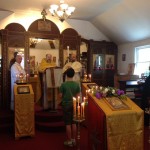
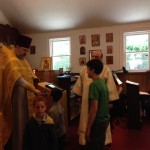
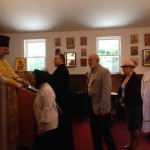
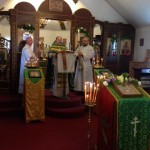
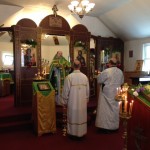
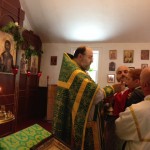
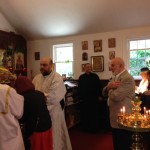
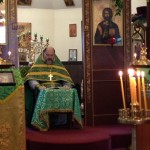
On April 17, on Holy and Great Thursday when the Church commemorates the Last Supper of our Lord Jesus Christ we had a service in St. George Church. Our Rector, Archpriest Igor Tarasov served Vespers with the Divine Liturgy of St. Basil the Great.
At the end of service he greeted the faithful who came to participate in that special Liturgy celebrated as a remembrance of the Lord’s institution of the Holy Sacraments of Eucharist and Priesthood..


Palm Sunday


On April 13, on Palm Sunday we had a solemn celebration of the feast of the Entry of our Lord Jesus Christ into Jerusalem. The Rector of St. George Church, Archpriest Igor Tarasov served the Divine Liturgy.
After the reading of the Hours the Rector blessed the pussy-willows and distributed them to the parishioners who were holding them during the service resembling the people of Jerusalem who greeted Jesus Christ with the olive and palm branches during His triumphal entry to the city.
Following the readings from the Scripture Fr. Igor preached a homily:

“Today is a great holy day of the Lord, His triumphal Entry into Jerusalem. It is a final celebration before we start mourning during the Passion week. It is a last bliss of joy we may have before we come to time of grief, before we begin to sympathize the Lord in His sufferings. This is why the message of today’s Epistle lesson is rather joyful. St. Paul exclaims, “Rejoice in the Lord always, again I will say, rejoice!” (Phil. 4, 4). He desires that we rejoice in the Lord and have no anxiety for anything.”
“When we hear these words of St. Paul we may feel like saying to him, “Come down to the earth! Who can live always rejoicing and without being anxious about anything? How can a mother with a sick child not be anxious? How can a person afflicted with cancer not be anxious? How can a business man at the time of economic crisis not be anxious?” But St. Paul says in today’s Epistle lesson: “Be anxious for nothing…” (Phil. 4, 6). And we should know that writing these words St. Paul was not thinking of some other world or some other life. When he wrote this advice he was having a pretty rough time himself. In fact, the words we heard today in the Epistle lesson were written when St. Paul was arrested, was probably in chains, and not in a comfortable chair in front of a fireplace. St. Paul was no armchair philosopher. He was a realist, well acquainted with life.”
“But if we read the whole advice of St. Paul in today’s Epistle lesson, we may see that he does not stop with these words. He goes on to teach us how to overcome anxiety. He says, “But in everything by prayer and supplication, with thanksgiving, let your requests be made known to God” (Phil. 4, 6).  Bring your anxiety to God, he says. And he continues assuring us that if we do so “the peace of God, which surpasses all understanding, will guard your hearts and minds through Jesus Christ” (Phil. 4, 7). If we tell God about our worries, about our problems and troubles, He will guard our hearts and help us. The word ‘anxiety’ is derived from the Latin word meaning to choke. A thing is choked when the outlet is blocked. That is exactly what causes our anxiety. There is no outlet for our worries and fears. They back up on us, set our b=nerves twitching, and fill our days and nights with fear. But we Christians have an outlet. It is God’s compassion through our Lord Jesus Christ, the blessed one who comes in the name of the Lord.”

“St. Paul teaches us today to make our fears and worries known to God by prayer, supplication and thanksgiving. These are the ways of doing that.”
“Jesus was no stranger to anxiety. He was terrible anxious in the Garden of Gethsemane just before His crucifixion. We hear Him saying, “Now My soul is troubled… Father, save Me from this hour…” (Jn. 12, 27) “Take this cup away from Me…” (Lk. 22, 42). But Jesus was praying and here comes relinquishment: “Nevertheless, not My will, but Yours be done” (Lk. 22, 42). After relinquishment comes peace: “Father, forgive them, for they do not know what they do” (Lk. 23, 34) “Father, into Your hands I commit My spirit” (Lk. 23, 46). Therefore, dear brothers and sisters, Jesus Himself gave us a perfect example how we can commend our anxiety to God by prayer and supplication.”

“In addition, our anxiety can be commended to God by thanksgiving. A lady visited a priest one day. She had many troubles to tell him. He told her he would gladly listen provided she would first tell him all she has to be thankful for. She agreed and for a solid half hour gave her many reasons for being grateful. After she finished, the priest said, “Now you can tell me your troubles.” To her surprise the lady found herself saying, “I really don’t think I have any”.  Thus, dear brothers and sisters, check your blessings, thank God for them, and when you are finished, you may be surprised to find that you are rather blessed than troubled.”
“The final cure for anxiety in today’s Epistle lesson is expressed by St. Paul when he tells us to fix our minds on whatever things are true, noble, just, pure, lovely, of good report and on any virtue and on anything praiseworthy (Phil. 4, 8). In other words, St. Paul calls us to think positive. In the midst of the storm of anxiety, fix your mind on Christ. Fix your mind on His power, on His love, on His great promises. Soak your mind with Christ and you will discover for yourself the true peace which surpasses all understanding, the peace of God the Lord who has appeared to us!”

For the first time in St. George Parish the Lord’s Prayer at this Liturgy was sung in the Georgian language. Since we have a family from Georgia among our parishioners the Rector blessed some occasional use of Georgian at our services.

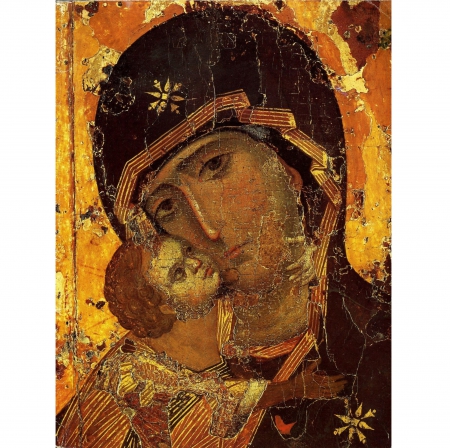
After the Liturgy dismissal the Rector and altar servers came before the stand in the middle of the church and performed the rite of glorification before the festal image  singing the troparia, the kontakion and the magnification of the feast.

The Rector congratulated the parishioners on the occasion of the holy day. He also reminded them that we are beginning Passion Week, a very important and spiritually intense time, and called to attend the services celebrated during that week.

After the service parishioners and the Rector enjoyed delicious meals and interesting conversation during the coffee hour.


Sacrament of the Anointing of the Sick


On April 12, on Lazarus Saturday the Rector of St. George Church, Archpriest Igor Tarasov celebrated the Mystery of the Anointing of the sick in our parish temple. All persons who desired to receive that Sacrament participated in the service and were anointed with the blessed oil. At the conclusion of the service Fr. Igor preached a brief sermon about the significance and importance of the Mystery of Anointing of the sick which is aimed for the healing of soul and body.


Fifth Sunday of Lent


On April 6, on the Fifth Sunday of Lent our parish had a nice liturgical celebration. The Divine Liturgy of St. Basil was served by St. George’s Rector, Archpriest Igor Tarasov in our temple. Following the lesson from the Gospel he preached a homily:

“On this Fifth Sunday of Lent we are again hearing a prophecy of Jesus Christ Himself that very soon He will be betrayed, condemned to death and killed, but on the third day He will rise again (Mk. 10, 33-34). Same prophecy we could hear in the Gospel lesson on the last Sunday (Mk. 9, 31). In this way we are prepared to commemorate the holy Passions of our Lord and to celebrate His holy Resurrection. One of the most important aspects of this holy time on which we should reflect is the whole idea of our Redemption through the sufferings and death of Christ. We turned to that idea many times during Lent. Today we need to think of it again.”
“Today’s Epistle lesson is relatively short, but it contains a very profound explanation of our Redemption. Writing to the Hebrews, St. Paul uses references to the Old Testament rules and rituals. Many of them contained offerings of certain sacrifices for the forgiveness of sins and for cleansing of the people. Our Redemption is a universal forgiveness of human sin and a universal cleansing of the human race. This is why St. Paul calls our Savior, Jesus Christ the High Priest who offered such a universal sacrifice. St. Paul says, “Christ came as High Priest of the good things to come, with the greater and more perfect tabernacle not made with hands” (Heb. 9, 11).  He goes on and says that Christ offered this sacrifice “not with the blood of goats and calves, but with His own blood” (Heb. 9, 12). Christ, in contrast to the Old Testament priests became a High Priest of the New Covenant. The Old Testament priests had to offer their sacrifices in the Temple many times. They did it for certain people who asked for that to cleanse their certain sins. And every year a high priest entered the Holy of holies with the bloody sacrifice for all the sins of the Jewish people committed during the year. Christ entered the heavenly, not earthly sanctuary once and for all, and obtained eternal redemption (Heb. 9, 12).  His one sacrifice covers all sins by all people for all time. His blood being a true human blood was shed on the Cross and healed our corrupt humanity. ”For if the blood of bulls and goats and the ashes of a heifer, sprinkling the unclean, sanctifies for the purifying of the flesh, how much more shall the blood of Christ, who through the eternal Spirit offered Himself without spot to God, cleanse your conscience from dead works”, says St. Paul (Heb. 9, 13-14).”
“The sacrifice of Christ was offered not only to forgive our sins. It also restored us to our proper relationship with God. It purified, cleansed our conscience from dead works. What are the dead works? They include all our human activity of this life, especially our evil or corrupt deeds. For St. Paul the dead works also meant the rituals of the Old Covenant which became dead after Christ. After Jesus Christ offered Himself on the Cross and redeemed the human kind, all previous sacrifices and offerings became useless. Now we need to serve not the letter of God’s law but the living God Himself (Heb. 9, 14).”

“Dear brothers and sisters! How very serious are the ideas given to us in today’s Epistle lesson! Let us keep them in mind and in our hearts, so we may be worthy of our Lord’s unique and universal sacrifice. He accomplished our salvation by His voluntary act of love. What can we offer to Him for that? Any gift would be insufficient to give thanks for our Lord’s grace. But we may at least try to be grateful for our Redemption by living according to His commandments and according to our conscience.”
“Referring to St. Paul, we may recall that for him the world was divided into two classes of people: the Jews who had the law given to them directly by God in written form, and the Gentiles who, although they did not have the written law, nevertheless had a God-implanted knowledge of right and wrong within their hearts. According to St. Paul, both would be judged by God. The Jews will be judged on the basis of the written law; the Gentiles on the basis of the law written not on tablets or books but in the hearts, on the basis of their conscience. We Christians have both. We have the written law and Commandments in the Scripture and Church discipline. We also have the law in ourselves, our conscience, the God’s voice within ourselves. Let us honor both and live by both.”

“Let us also remember that the written Commandments and our conscience can guide us, can warn us, can instruct us. But there is one thing that they cannot do. They cannot undo the wrong we have done. They cannot heal the wounds we inflict. They cannot eradicate guilt. They cannot forgive sins. Only Christ can do that. Only the blood of Christ can purify our conscience. Only He can forgive and heal and erase the past. He did it once and for all and He continues to do it for each of us. Let us then follow Him through His holy Passions to His victory of the holy Resurrection!”


Fourth Sunday of Lent


On March 30, on the Fourth Sunday of Lent the Rector of St. George Church, Archpriest Igor Tarasov celebrated Divine Liturgy in our temple. After the Scripture readings he preached a homily:

“Fourth Sunday of Lent is dedicated to the great spiritual writer and champion of faith, Venerable John Climacus. His book about achieving spiritual perfection in monastic life, called “The Ladder of Divine Ascent” is very famous among the Orthodox who desire to conduct a life of prayer and spiritual endeavors. The Ladder describes how to raise one’s soul and body to God through the acquisition of ascetic virtues. Each chapter is referred to as a “step”, and deals with a separate spiritual subject. There are 30 steps of the ladder, which refer to the age of Jesus at His baptism. Commemorating St. John of the Ladder the Church wishes us to be patient in our own spiritual life, in our achievements and failures during this difficult journey. We need patience to have hope that we may be successful in our salvation.”
“In today’s Gospel lesson our Lord Jesus Christ Himself showed that being a man He had to exercise patient, but was about to lose it. He exclaimed that He is tired to live among the faithless people and to bear with them (Mk. 9, 19). Today’s Epistle lesson is also telling us something about patience and about hope. Those two virtues always go together. If we have hope we must have patience to wait for a hope to be fulfilled. If we have patience, then we can hope for anything. St. Paul calls us today to “imitate those who through faith and patience inherit the promises” (Heb. 6, 12). Then St. Paul tells us about Abraham. God had promised to multiply the seed of Abraham. But Abraham had to exercise patience before he received the promise. It was not until 25 years after God’s promise that his son Isaac was born. Abraham was old, his wife Sarah was barren, but Abraham waited patiently, trusting in the promise of God.”
“Imagine waiting 25 years for God to fulfill a promise! That a patience! That a hope! Contrast this with the mood today which everything to be instant. Instant sound from the radio, instant direct-dialing to any spot of the world, instant photos, instant riches, instant food, instant divorce, instant suicide… So people ask: “Why not instant prayer? Why wait for 25 years, as Abraham did, for an answer to prayer? Why not right now?””

“When a father asked a college dean for an instant education for his son who did not want to spend 4 whole years in college, he received a reply: “Certainly, I believe I can arrange for that. Of course, it all depends on what you want to make of your boy. When God wants to make an oak tree, He takes a hundred years. When He wants to make a squash, He takes only two months”.”
“We need patience in order to achieve our goals. This is why St. John of the Ladder describes the whole 30 steps in achieving perfection in ascetic life. On the 30th step of the Ladder is God Himself. And we have to say that God, being a perfect example of everything which is good, is the supreme example of patience. He is patient with each one of us, always giving us another chance, another year, another opportunity to repent, to return to Him. He is ready to wait for us to bear fruit for Him like a fig tree in a parable told in the Gospel (Lk. 13, 8-9).”

“If God Himself is patient with our sins, our transgressions and evil deeds then we should learn to be patient. We see that we usually want everything instantly, but God is the One who knows how to wait. Therefore, let us admit that patience is not a human achievement. It is a fruit of the Holy Spirit within us (Gal. 5, 22). We must pray for it. It is a virtue we receive when we live in Christ.”
“Having patience as a fruit of the Holy Spirit, as a virtue obtained in a pious life, we may have hope. St. Paul in today’s Epistle lesson calls the hope “an anchor of the soul, both sure and steadfast, and which enters the Presence behind the veil” (Heb. 6, 19). What a beautiful description! An anchor is usually thrown from a ship to secure it in a certain place. Thus St. Paul compares our soul to a ship wandering in the storms of the sea of life. The hope makes it secure, it is an anchor of our soul. This anchor is both sure and steadfast. It also reaches not the depth of the sea, but it enters behind the veil of God’s essence, of the very existence of the Almighty which is a mystery. But through Jesus Christ who became man we can reach there by hope. Christ, as St. Paul says, was the forerunner who entered behind that veil for us (Heb. 6, 20). Just like a high priest in the Temple of Jerusalem could enter behind the veil of the Holy of Holies to offer a sacrifice for the chosen people, so Jesus by His sacrifice on the Cross had entered behind the veil of God’s presence for us. He became High Priest forever according to the order of Melchizedek for the whole human kind. Heaven is still behind the veil for us who live an earthly life. But because of Jesus the High Priest heaven may be open for us when we leave this earth. Our hope is there. It is like an anchor of our soul firmly and securely fixed behind the veil.”

“Dear brothers and sisters! Let us be patient. Let us exercise patience and endure in our spiritual life to achieve fruitful results. Let us try to ascend to God step by step on the ladder which is described by Venerable John Climacus. Let us endure like Abraham to receive the promise of the Most High. Let us pray for the gift of patience, for this precious fruit of the Holy Spirit. Let us cherish our hope which can firmly unite us with God, our Lord Jesus Christ.”

Upon the Liturgy dismissal Fr. Igor called the parishioners to keep in mind the example of the Venerable Father Alexis, the Man of God whose memory we celebrate on that day. Orthodox Christians should imitate his humility and modesty.

Sunday of the Veneration of the Cross


The Third Sunday of Lent is dedicated to the veneration of the Cross. On that day, on March 23 the Rector of St. George Church, Archpriest Igor Tarasov celebrated the Divine Liturgy in our temple.
Before the reading of the Hours the Rector solemnly transferred the decorated cross from the altar to the middle of the church and placed it on the analogion stand.

During the Divine Liturgy, following the lessons from the Scripture Fr. Igor preached a sermon:

“On the Third Sunday of Lent Orthodox Christians have a ceremony of the flowering of the cross. In different countries and regions people use different flowers or herbs to decorate the cross, but the ceremony is basically the same. The cross adorned with flowers or greenery is placed in the middle of the church for veneration. This ceremony signifies that what was once an object of execution has now become a door that leads us into God’s presence producing new life in great beauty and fragrance. The cross is presented to us in the middle of Lent as a reminder of God having drawn near to us in Christ.”
“Today’s Epistle lesson has some words about drawing near, coming boldly. There are those who believe that the whole essence of the Epistle to the Hebrews is captured by this phrase: “Let us therefore come boldly to the throne of grace” (Heb. 4, 16). Its central idea is that it has now become possible through Jesus to approach God freely.”
“It was not always so. The tragedy of the Garden of Eden was that Adam and Eve lost God. They ran away from Him. They separated themselves from Him. A great wall was erected between God and man – the wall of man’s sin and separation.”

“It was not possible for man to “come boldly to the throne of grace.” In the Old Testament Temple a great curtain separated the Holy of Holies from the people. No man could enter the Holy of Holies but the high priest – and only once a year on the Day of Atonement. And he was not to linger too long in that holiness “lest he put Israel in terror”. There were tiny bells along the hem of the high priest’s robe to announce his every movement in the Holy of the Holies (Ex. 28, 33-35). Orthodox bishops to this day wear these bells on their robes. Those outside would know if the high priest had died in God’s presence by the absence of the tinkling sound. For no man could see God and live. Moses heard God say: “You cannot see My face; for no man shall see Me and live” (Ex. 33, 20). God’s name was so holy that it was forbidden for the Jew to use it. If there was one word to describe God in the Old Testament, it would be the word “unapproachable”.”
God’s great plan of redemption in Christ had one supreme purpose – to break dawn the barrier of sin which made God unapproachable, to return man to God. The cross which forgave man’s sin and guilt was God’s way of removing the barrier that separated man from Him, in order that man might again live with God and walk with Him as in the Garden of Eden.”

“The entire ministry of Christ on earth was a testimony to the fact that God is approachable. Over His life, then and now, stand the glorious words, “Come to Me, all you who labor and are heavy laden, and I will give you rest” (Mt. 11, 28).”
“This is why, let us come boldly to Christ! Jesus has no favorites, only intimates who like the Apostle John share with Him their love and devotion. “No longer do I call you servants… but I have called you friends”, says Jesus (Jn. 15, 15). He offers an intimacy with God which was impossible before His coming.

“So, let us come boldly to Him. Let us draw near. Let us come to Him through prayer. The purpose of prayer is to connect our life to God so that His love and power may flow through us into the lives of others around us. Let us come to Him through Holy Communion. Every Liturgy we hear the words, “With the fear of God, and with faith [and with love], draw near”. By these words the priest invites the faithful to receive Communion.”

“Come boldly to Him when we have problems, pain and suffering. When the storms of life roar about you, draw near! Christ has opened a new living way to God. The veil is rent. The wall is down. We have access to grace, access to the Father, access to the Holy Spirit, access to power, access to God’s mercy, and Christ is our High Priest to represent us in the Holy Place of God’s throne. So let us come boldly not tomorrow, but today. For tomorrow is not ours. Tomorrow may never come. Tomorrow may be too late. “Seek the Lord while He may be found, call upon Him while He is near”, says the Prophet Isaiah (Is. 55, 6).”
“Dear brothers and sisters! Let us come boldly with confidence, with faith, with hope, with love to Jesus, to His Cross which we honor today, to His throne of grace, to be accepted by Him forever!”

Upon the Liturgy dismissal the Rector and altar servers came out of the sanctuary before the stand in the middle of the church and venerated the Precious Cross.

After the service Fr. Igor made a brief speech to call the parishioners not to relax in the middle of Lent but to continue spiritual endeavors of prayer, fasting and the works of mercy.


Second Sunday of Lent


On March 16, on the Second Sunday of Lent we had a nice celebration in St. George Church. Our Rector, Archpriest Igor Tarasov served the Divine Liturgy. After the reading from the Holy Gospel he preached a homily:

“On the Second Sunday of Lent we are called to reflect upon our salvation. On this day the Church commemorates our Father among the Saints, Gregory Palamas who was a great theologian and spiritual writer. In his writings he stressed the idea that men are able to obtain the divine energy, the grace through spiritual life of prayer and devotion. He wrote that godly people may become partakers of the Divine nature. This is an important way of salvation. But among other things, salvation means forgiveness of our sins. Today’s Gospel reading tells ua about God’s power to forgive. This power was possessed by the Son of God and then given to the Church who now is able to absolve us from our sins in the Mystery of Penance. That Sacrament requires our conversion; it does not work automatically. If we repent and show compunction, then God through the ministry of the Church will forgive us. In a similar way, today’s Epistle lesson is telling us about the importance of our cooperation with God for our salvation. St. Paul is warning us and says, “We must give the more earnest heed to the things we have heard, lest we drift away. For if the word spoken through Angels proved steadfast, and every transgression and disobedience received a just reward, how shall we escape if we neglect so great a salvation…” (Heb. 2, 2-3). St. Paul is warning us that we should be watchful and give a lot of attention to the spiritual matters. Otherwise we may drift away from salvation; otherwise we may not escape being condemned by God at the end of days.”
“Our salvation is the most important goal of our life. The dogma of salvation is the central dogma of Christianity, the very heart of our faith. Our Lord Jesus Christ is the Redeemer and Savior of all mankind. Because of Christ’s birth, His Incarnation and His life lived for our sake, crowned with His death and Resurrection, we see how infinitely important mankind is to Almighty God. We are precious for Him, and His mercy endures forever. God took upon Himself our guilt, our sins and our faults. He is the Lamb slaughtered for an ungrateful world. This is the heart of human history, the very reason why we were created.”
“Some Christian churches stop here and make a conclusion that Christ has already accomplished everything for us: He redeemed and saved us, thus we are saved if we accept Him and believe in Him. But we, being a traditional Church, a Church which follows the teaching of the Holy Fathers, do not stop here. We add something else because we cannot be sure that if we are called for salvation, then we are already saved. Salvation must be deserved. This is why we say that in order to be saved we need to do the works of faith. St. Gregory the Great (not St. Gregory Palamas whom we honor today, but another St. Gregory, the pope of Rome) wrote, “Perhaps each of you will say to himself: I have believed, I shall be saved. He speaks what is true if to faith he joins good works. That indeed true faith which does not deny in work what it professes in word. For this Paul says of certain false faithful: “They profess to know God, but in works they deny Him” (Tit. 1, 16). For this John also says: He who says that he knows God, “and keeps not His Commandments, is a liar, and the truth is not in him” (1 Jn. 2, 4)”.”

“One of such works of faith is our repentance which is so important to receive forgiveness of our sins. This is why we are reminded about it during this blessed time of fast and on this Second Sunday of Lent.”
“Dear brothers and sisters! Salvation is not something already done. It is a process that is, at the same time, past, present, and future. There is nothing in the Scripture and in the Fathers to defend the idea that all one has to do to be saved is to profess that “Jesus is Lord” and your salvation is assured! Salvation is not momentary; it is a life-long process. Christ Himself said, “Not everyone who says to Me, ‘Lord, Lord,’ shall enter the Kingdom of heaven, but he who does the will of My Father in heaven” (Mt. 7, 21). Also St. Paul stated that we need to work out our own salvation with fear and trembling (Phil. 2, 12). This is why those who teach that salvation is done after your mere statement of belief, or after some “holy moment”, are very wrong.”

“Every Christian can say, “I was saved when Jesus died for me on the cross”. But he should continue, “I am saved because I accept Redemption as part of my Baptism into the very life of Christ. Christ is my Savior, but I must prove that I believe He is my Lord by my long-life actions as a faithful Christian.” Finally everyone can say, “I will be saved when my earthly life is over and I will be judged as to whether my actions supported my words of faith in Christ as Lord and Savior”. This is why in answering the question, “Are you saved?” the Fathers respond, “I am being saved.” Anything other than this is sheer presumption on our part, and against the teaching of Christ!”

“Dear brothers and sisters! Let us not neglect so great a salvation offered to us by the Lord. Let us respond to God’s power of forgiveness by good works of faith, by repentance, so we may indeed become saved.”

Sunday of Orthodoxy


On March 9, on the First Sunday of Lent when the Church celebrates the Triumph of Orthodoxy we had a solemn liturgical service in our temple. On this day we also observe the feast of the Finding of the precious Head of St. John the Baptist. Rector of St. George Church, Archpriest Igor Tarasov celebrated the Divine Liturgy of St. Basil the great. Following the Gospel lesson he preached a sermon:

“Today’s first Epistle lesson tells us about the faith of many Old Testament heroes. It says about their endeavors and states that all these great achievements of the righteous men and women were reached because of faith. It is important for us to note because today we celebrate the Triumph of Orthodoxy, we celebrate the victory of the true Christian faith. We commemorate the decisions of the 7th Ecumenical Council of Nicaea and later achievements of the Orthodox Church in establishing the true faith concerning veneration of the holy images. Today is Sunday which celebrates the holy icons. This is why today we sing: “We venerate Thy most pure icon, o Good one…” Orthodox faith means that we believe in God’s Incarnation, we believe that God took our flesh, our human nature. God became man. “The Word became flesh”, as the Gospel says (Jn. 1, 14). Since God became man we can and should image Him and make His icons. We have to venerate them. This is one of the important parts of our faith. Along with all other sacred dogmas it constitutes holy Orthodoxy, the true treasure we all possess.”
“In today’s Epistle lesson St. Paul says: “By faith Moses, when he became of age, refused to be called the son of Pharaoh’s daughter, choosing rather to suffer affliction with the people of God than to enjoy the passing pleasures of sin, esteeming the reproach of Christ greater riches than the treasures of Egypt” (Heb. 11, 24-26). Faith made him choose to renounce the riches and power and to become a leader of the Israelites. Adopted by the Pharaoh’s daughter, Moses had been brought up in great luxury of Egypt. He was heir to a kingdom. But he had never forgotten his people. And the day came when he decided to join them. To do so, he left behind the riches and power, the royalty he might have had.”
“Moses gave up earthly glory for the sake of the people of God. He chose the loyalty that led to suffering rather than the ease which led to glory on earth. He chose to suffer for the right than enjoy luxury with the wrong. His faith made him understand that the treasures earth had to offer were of no comparison to the ultimate reward of God. So St. Paul says that he considered “the reproach of Christ greater riches than the treasures of Egypt; for he looked to the reward” (Heb. 11, 26).”
“In the same way, many other righteous men and women in the world, those described in the Scriptures and those who lived later than the Scriptures were composed, made their choice. They gave up the riches, or comfort, or other advantages of this world and preferred to follow God, to do the right thing and to look to the reward from God. One of them was St. John the Baptist whose feast we celebrate today. St. John could live a comfortable life if he would be nice to king Herod. The king liked him and enjoyed his speeches and sermons. But when St. John began to criticize the king, to say to him that he is doing inappropriate things, he was imprisoned. Later the king’s illegitimate wife used her influence to force the king to execute St. John. He was beheaded. Later in the history, his precious head was uncovered three times by the faithful people. Today we celebrate the first and the second finding of St. John’s head. St. John also, like Moses considered the reproach of Christ greater riches than any treasures of the world.”

“One of the marks of true wisdom is to be able to discern the real treasures in life; the ones that last and bring true happiness. Many people labor for treasures that turn out to be no treasures at all. A poem says,
He used his health

To store up wealth
Then spent his wealth

To get back health
And only got a grave.

“Dear brothers and sisters! The real treasure we possess is our Orthodox faith. We inherited it being born to the Orthodox parents or being converted to the holy Orthodoxy. We received it by getting baptized in one, Holy, Catholic and Apostolic Eastern Church. It is up to us now to preserve that wealth or to renounce it by preferring the ideals of the sinful world. If we choose the riches of the world and lose our treasure of faith, then we will end up with nothing. The wealth of the world will disappear when we die. The world itself will end one day. But if we choose faith and life according to it, then it will lead us to a reward, the same reward Moses and other righteous people were looking to. Looking to such reward will be looking unto Jesus, the Author and Finisher of our faith, as today’s Epistle says (Heb. 12, 2). Let us look unto Jesus! Let us look now at Him on His holy icons. Let us venerate them. Let us have them as an encouragement for our own endeavors of faith. Led by His light shining through the holy icons, we will some day see, as our Lord says in the Gospel, “heaven open, and the angels ascending and descending upon the Son of Man” (Jn. 1, 51).”

After the Liturgy dismissal the Rector performed prayer service of the Sunday of Orthodoxy.


Compline with penitential Canon of St. Andrew on the first week of Lent


On March 5, on Wednesday of the first week of Lent the Rector of St. George Church, Archpriest Igor Tarasov served the Compline with the reading of penitential Canon of St. Andrew of Crete.

Following the service the Rector preached a brief sermon about the meaning of penitential Canon and called the parishioners for repentance and awareness of the sinful state of every person. The Canon which is composed as a conversation of a person with his own soul reveals that often we imitate sinners mentioned in the Scripture. It also encourages us to bring the fruits of repentance and not to exalt ourselves.


Cheesefare Sunday


On the Cheesefare Sunday the Church commemorates the exile of Adam and Eve from paradise. This day is also known as the Forgiveness Sunday because Orthodox Christians ask mutual forgiveness before they begin the spiritual journey of the Great Lent. On this day, on March 2, St. George parish had services in our temple. Our Rector, Archpriest Igor Tarasov celebrated the Divine Liturgy. After the reading from the Gospel he preached a homily:

“Today’s Epistle lesson is telling us just before the blessed time of Lent that we should put away all our desires of flesh and evil mind. The words of St. Paul sound very impressively. He announces and calls: “The night is far spent, the day is at hand. Therefore, let us cast off the works of darkness, and let us put on the armor of light” (Rom. 13, 12). This is our main advice for the beginning of Lent.”
“In his Epistle St. Paul enumerates certain sins of flesh such as revelry, drunkenness, lewdness and lust. Then he mentions envy and places it in the same category (Rom. 13, 13). Envy is a sin of the spirit, of the evil mind. Yet St. Paul mentions it here. We may recall the parable of the Prodigal Son that was read to us two weeks ago. The younger brother in that parable sinned in the flesh while the older brother sinned in the spirit – in envy, or jealousy. In the end, the one who sinned in the flesh was on the inside of the father’s house, and the one who sinned in the spirit – in envy – was on the outside. Envy can close the doors of the Kingdom of God just as tightly as lewdness and lust. Of the sins of the spirit, the vice of envy or jealousy is near the top of the list.”
“Let us recall that the devil has been tempting us with jealousy and envy since the beginning of man. Today we commemorate the expulsion of the first man, Adam from paradise. Adam and Eve were expelled from the state of blessedness because they violated the only commandment God gave them: not to eat the fruit from a certain tree. They broke that commandment by eating the forbidden fruit. But they were tempted to do that, tempted by the devil. Holy Fathers say that before God created man the devil found out that God desired to create man according to God’s image and likeness. The devil was created before man, along with other Angels. He had a great knowledge and somehow he found out about God’s plan. It became known to him that even if man falls, God desired to save him by sending His Only-begotten Son and by redeeming human kind. Because of that, as the Holy Fathers teach, the devil became kindled by envy and decided to tempt Adam and Eve to sin, to raise against God. And they did. Thus, the paradise was lost because of the devil’s envy. Although the sin of Adam and Eve was the sin of disobedience, not envy, but the devil’s envy was the reason for that.”

“Later, when Cain and Abel brought their offerings to God, God accepted Abel’s sacrifice and rejected Cain’s. Cain was so jealous that he killed his brother. The world first murder was born of jealousy. Further the Old Testament tells us that because of jealousy the brothers of Joseph sold him to slavery. And the New Testament tells that our Lord Jesus Christ was crucified out of jealousy. Pilate knew that “the chief priests had handed Jesus over to him because of envy” (Mk. 15, 10). It was envy that crucified the Lord!”
“St. Paul offers us a way out of jealousy and envy. “Put on the Lord Jesus Christ,” he says in the Epistle lesson (Rom. 13, 14). It means every day we have to imitate Christ, to put on ourselves His compassion, His kindness, His forgiveness, His meekness, His patience, and above all His love. It means to put on Jesus Christ by receiving Him in Holy Communion. He then will fill us with love – the love which is patient and kind, the love which “does not envy, does not boast, and is not proud” (1 Cor. 13, 4).”

“A second way of fighting envy offered by St. Paul is found in the words, “Make no provision for the flesh, to fulfill its lusts” (Rom. 13, 14). Kill your spiritual enemies by starvation, he says. Destroy them by neglect. Make no provision for them. Deny the fuel and you exhaust the flame. Here fasting is very handy. In fact, tomorrow we begin Lent, and we are called for a strict abstaining from certain foods. But it is difficult by itself. It should be strengthen by prayer and repentance. We must confess our envy to Christ. We must pray to be blessed by Christ’s love. Envy cannot exist in the atmosphere of prayer, fasting and repentance.”
“Dear brothers and sisters! Let us destroy the enemies of our soul by putting on Jesus Christ and by making no provisions for flesh. Let us pray that the Lord may help us, especially during this blessed Lenten season we are about to begin. Let us ask God to assist us to overcome our weaknesses, to become closer to Him through prayer, fasting and repentance. Let us cast off all the works of darkness and begin this fruitful season with our Lord’s blessing!”

During the Litany of fervent supplication the Rector added special petitions for multiplication of love and eradication of hatred in the land of Ukraine.

Following the Divine Liturgy the Rector performed Vespers with the Rite of Forgiveness. After the singing of the Great prokimenon he changed his priestly vestments to the Lenten color of black. Following the Vespers dismissal Fr. Igor preached a brief sermon about Lent. He compared the period of Great Fast with the 40-day fasting of our Lord Jesus Christ in wilderness and with the 40-year wandering in wilderness of the Jewish people before they could enter into the Promised Land. Even Moses, the leader of the Jews was not blessed to enter that land because of his shortcomings. Our promised land is the Kingdom of God, but our temporary goal is to reach worthily the celebration of the glorious Resurrection of Christ. Lent is a journey towards that celebration. And we need to get there. We will if we walk through Lent by strengthening our spiritual life: by prayer, fasting, repentance and the works of charity. But before we begin we have to ask mutual forgiveness for all possible offenses and trespasses, for the Lord said in today’s Liturgy Gospel lesson that if we do not forgive others their trespasses God will not forgive us our sins (Mt. 6, 14). Therefore, the Rector called the parishioners to forgive him and each other.

The Rector asked for forgiveness bending his knees. The parishioners also knelt down and asked their pastor for forgiveness. Then each one of the faithful could come to the Rector to kiss the cross and to express forgiveness.

After the services of this special day the Rector and parishioners joined at the Blini Lunch. We enjoyed delicious meals, especially the blini, nicely prepared by our ladies.