Exaltation of the Holy Cross


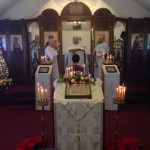
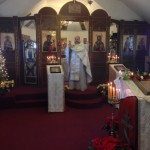
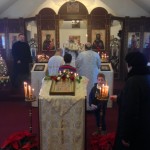
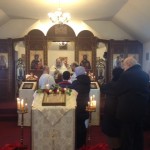
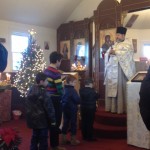
On September 27th, on the feast of the Exaltation of the Precious and Life-giving Cross, we had a solemn celebration at our temple. Before the Hours St. George’s Rector, Archpriest Igor Tarasov placed the cross in the middle of the church and venerated it.

At the Divine Liturgy, after the Gospel lesson Fr. Igor preached a homily about the feast of the Cross:
“Today we heard the Gospel lesson about the sufferings of Christ on the Cross. Even though the Evangelists do not tell us all the cruel and violent details of that execution, we can imagine how terrible it was. God died in horrible pain for us, the sinners. He was left alone, rejected by His own chosen people, betrayed by His disciple, abandoned by His followers. Only a few people like His Blessed Mother, some myrrh-bearing women and His close disciple, Apostle John, remained faithful and were present under the Cross. Jesus accomplished our salvation through these holy Passions.

“If we think of those holy Passions and death on the Cross, we may see that it was terrible, but also glorious. As St. Nikolai of Serbia says, “It was the end, but at the same time it was the beginning : the suffering of the God-man and the beginning of His glory, the end of the self-deception of the Jews and the beginning of the unique thing in human history – the miracle that called the Church of Christ, which became the mother of Christian civilization on several continents inhabited by barbarians . When a person reads a description of the suffering of our Lord Jesus Christ, he may have two feelings : the sense of horror from the madness and cruelty of some people and the feeling of delight from an elevated thoughts and love of Christ”.”
“That horror of the Cross, of the idea that God Himself died on the Cross, would be impossible to endure, if it did not give a delight. It is an interesting contradiction. Let us say that your brother did something bad to you. You may be offended and hate your brother. But if you look at that remembering that it is your brother, then you can endure the insult, you can stand it.”
“A certain man planted a garden of fruit trees, but the wildings, bad fruits grew . He came to prune and to take care of the trees, but the prickly branches wounded his hands and scratched his face. The gardener became angry , but in his anger he did not take an ax to uproot the trees , but suffered all , because he knew that it was his garden. So was the Son of God Who endured all the torments caused to Him by the people , always bearing in mind that mankind – this is His garden, His creation , and He is called not to cut down wild planting, but to make them noble, even at the cost of His own blood.”

“The love of Christ represented by His Cross surpasses everything. This is why when we also suffer or have any trouble time, let us recall the Cross of Christ. Let us imagine ourselves under the Cross, along with the Most Holy Mother of God, the myrrh-bearers and with St. John. Let us come to the Cross where Jesus is ready to embrace us. Let us come into His embrace.”
“Let us remember that the Cross, as we sing today, will protect the people of God, will give us an unconquerable victory over all our tribulations, pains and sufferings. Let us come to venerate the Cross today and let us extol it in our hearts, in our lives to endure with Christ and to vouchsafe to be the partakers of His glorious Resurrection.”

Following the end of the Liturgy the Rector and parishioners venerated the Cross.

Sunday before the Exaltation

On September 22, on Sunday before the Exaltation of the Cross, Archpriest Igor Tarasov celebrated the Divine Liturgy at St. George Church. After the readings from the Sacred Scripture our Rector preached a sermon interpreting today’s Epistle lesson.
Fr. Igor said, “On a Sunday preceding the feast of the Exaltation of the Cross we are given a separate set of readings from the Sacred Scripture. The Church does so to make us aware of the special meaning of the Cross of Christ. Today’s Epistle lesson from the Letter of St. Paul to the Galatians concerns with the issue the first Christians had, the issue whether they should keep the Jewish customs and retain circumcision or not. St. Paul says, “For in Christ Jesus neither circumcision nor uncircumcision avails anything, but a new creation” (Gal. 6, 15). It does not really matter whether we are circumcised or not, but we have to be the new people in Jesus Christ.
“St. Paul is teaching that it is not something external on our bodies that distinguishes us as Christians. It is something internal, spiritual. Through Christ, through Baptism, through repentance and the Holy Spirit we have become new people, a new creation. Jesus Himself said, “Behold, I make all things new” (Rev. 21, 5). In Christ we are a new creation. He established the New Testament, thus the followers of that New Covenant have to be the new people, people who put off the old Adam and put on the new. “Put off… the old man which grows corrupt according to the deceitful lusts… and put on the new man which was created according to God”, says St. Paul in another Epistle (Eph. 4, 22-24). Thus, we have to be a new creation.

“Unfortunately the task of becoming the new people in Christ is still very difficult. Sometimes we do not see a difference between believers and unbelievers, between Christians and non-Christians… If we look at the human history, we see that man’s external environment has changed very much, especially recently, with the great achievements in science and technology. However, human nature did not change. Some wise man said, “Man has exalted change in everything but himself”. Man can change his appearance and the way he lives, but the most important change he does not make, a change inside of his soul. Unless man changes inside, unless he is born again, all the changes in science, technology or in our environment will be of no avail.”
“A wise man of the Old Testament said, “There is nothing new under the sun” (Eccl. 1, 9). At that time, centuries before Christ he could not see anything new. But today we know that the only new thing under the sun is the life in Christ. We know how unstable Simon became Peter, the Rock, greatest Apostle of Christ. We know how Saul, one of the worst enemies of Christ became Paul, the Apostle of nations, the author of the Epistles we now discuss. They became totally new creation in Christ!”

“Therefore, dear brothers and sisters in Christ, let us really build our lives the way we may be seen as the new people, people distinguished from the unbelievers. Let us be that new creation. Not circumcision or other external sign should distinguish us, but the sign of the Cross. And not just a visible sign, a cross we make or a cross we wear on our chests. Let us imitate the Lord crucified in our way of life, so we may say as St. Paul said in today’s Epistle lesson, “I bear in my body the marks of Lord Jesus” (Gal. 6, 17). For Paul these were the real marks. He was suffering for Christ and could have visible marks of those sufferings. But he also had spiritual marks of the Holy Cross of Christ, because he crucified his flesh with its passions and desires (Gal. 5, 24). By Christ the world has been crucified to Paul, and Paul was crucified to the world. (Gal. 6, 14). If we also crucify our flesh, our passions and sinful desires, then we may become the new people in Christ.  If we also make the world crucified to us and become crucified to the world, we may bear the marks of Lord Jesus crucified. These marks won’t be seen, but they will be in our hearts. These marks won’t be external, but internal. They would make us the true members of the Body of Christ, where “neither circumcision nor uncircumcision avails anything, but a new creation” (Gal. 6, 15).

Nativity of the Most Holy Mother of God


On September 21 the Church celebrates feast of the Nativity of the Most Holy Mother of God. On that day we had a festal service at St. George Church. Our Rector, Archpriest Igor Tarasov celebrated the Divine Liturgy. Following the reading from the Gospel Fr. Igor preached a homily.

The Rector expressed his regret that not too many parishioners came today to honor the Blessed Mother on the occasion of Her Birthday. We usually remember the birthdays of our loved ones and friends, we try to greet them and attend their birthday parties. However, sometimes we forget about our Blessed Mother’s day of birth.
Further Fr. Igor in his sermon shared the following thoughts: “Today the Church describes this feast by such a beautiful expression, “The barrenness of our nature has been loosed”. It says so because the whole human nature was spiritually barren, not able to give any good fruits. After the sin of Adam and Eve all men were deprived of spiritual fruitfulness. Only our Lord Jesus Christ could loose that barrenness and lift up the curse. In Christ our nature became fruitful again. But Jesus Christ had to be born of the Blessed Mother. Her Birth we celebrate today. This is why we sing these beautiful words about Her Nativity.”

“Now, in Christ all of us have to be spiritually fruitful, to bear a fruit of spiritual life. There is no requirement for all of us to be married and have children. But in any moment of our lives we have to be spiritually sane and active and bear spiritual fruit. We have to listen to the voice of Christ and follow Him. If we do so, then the fruits of our behavior, of our lifestyle will be appropriate.”
“Honoring the Most Holy Mother of God we should also honor Her holy parents, Joachim and Anna. They are examples to all parents, teaching us how to bring up children in piety. St. Joachim and Anna worked together with the Holy Spirit, with spiritual truth. This was the beginning of their joy. If we can do the same, it will be the beginning of our joy too. We too can free ourselves of the barrenness of our nature, if we stop thinking about our material well-being and start thinking about our spiritual well-being. Then we too will give birth to spiritual fruit like holy grandparents of God Joachim and Anna.”

“During Christmas time when we celebrate the Nativity of Christ, we say “God with us”. Today, on the birthday of the Theotokos, we may say, “Holy Mother of God is with us”. She may help us to follow Her Son and intercede for us before Him. Holy Mother is now with us. Let us rejoice!”

12th Sunday after Pentecost


On September 15, on the 12th Sunday after Pentecost we had a usual celebration of the Divine Liturgy. It was served by St. George’s Rector, Archpriest Igor Tarasov.
After the Scripture readings Fr. Igor preached a homily explaining the Epistle reading. He said that every Sunday is a celebration of the Resurrection of Christ, a ‘little Pascha’. And today’s Epistle reading reminds us of the Resurrection of the Lord.
Fr. Igor continued saying, “During Paschal season we greet each other by the joyful words, “Christ is risen!” But how can we believe it is true; how can we admit that Christ is truly risen? St. Paul calls the witnesses. This is his method to convince the Corinthians. He refers to five appearances of Jesus after His Resurrection: to Peter, to the twelve Apostles, to over of 500 brethren, to James and all the Apostles and then to himself. St. Paul considers Christ’s appearance to him on the road to Damascus an appearance of the same kind as all other appearances of the risen Christ to His Disciples, even though it happened 6 years after these appearances. 6 years passed after Christ Resurrection and His Ascension into heaven. Yet St. Paul places his special experience of meeting Christ on the Damascus Road in the same row as the appearances of the risen Lord. He does so because for him it was a real Resurrection experience. That appearance changed the history of many nations. It transformed a fanatical persecutor into Christ’s greatest friend; it gave Christianity a great teacher; it gave the New Testament its chief author; it granted many people, especially Gentiles, their first preacher of the Gospel, their true Apostle.”

“St. Paul says, “Last of all He was seen by me also, as by one born out of due time” (1 Cor. 15, 8). Paul did not belong to the original group of Disciples. He came after them. Thus he says that he is “the least of the Apostles… not worthy to be called an Apostle” because he “persecuted the Church of God” (1 Cor. 15, 9). He called himself the chief of the sinners. Yet he admitted that Christ had chosen to reveal Himself to him. He felt it was not due to his merits, but an act of pure grace and mercy on the part of God. He writes, “But by the grace of God I am what I am” (1 Cor. 15, 10).
“The early Church decreed that no one could be called an Apostle if he had not personally seen the risen Jesus. St. Paul always insisted that he had this essential qualification to testify from personal knowledge of Jesus. He utters, “Am I not an Apostle? Am I not free? Have I not seen Jesus Christ our Lord?” (1 Cor. 9, 1). How could he see Jesus Christ if he was not among the Apostles at the time when Jesus was on earth? Only by his very special, intimate and real experience of meeting the Lord on the road to Damascus. Finally, Jesus did appear to Paul, appeared last of all, as to “one born out of due time”.”

“Let us remember that Jesus Christ is the same yesterday, today and forever. If He came then, He comes now. Jesus comes to us now in our sense of sinfulness to forgive us, in our grief to comfort us, in our doubts to give us hope, in our fear to uphold us. He is not just a great Teacher and a beautiful example. He is the Son of God, the risen Lord, the Conqueror of death. He appears to us Christians and may appear to unbelievers to make them believers. And let us remember that when Christ does appear to the people, He does it as a pure grace. We can never deserve His attention. We are not worthy of His appearance. However, out of His love for mankind and His rich mercy He blesses us with His coming. This is a gift of God. It is priceless, but we receive it free of charge. This is important to know: the divine grace is not given for certain good deeds or merits, but freely. It is a special gift to the sinful and unworthy men. But it is able to make those sinful men holy and the unworthy crowned with dignity. It saves our souls and gives eternal life.”
“The grace of God may be bestowed any time. Some get it early, some later. This is why even a great sinner can repent and change his life. St. Paul did so. The grace may be bestowed “last of all” as happened to St. Paul.

Fr. Igor concluded his homily saying, “Therefore, dear brothers and sisters, like St. Paul, let us be humble, but let us also be sure that the risen Lord may bestow His grace upon us and come to us to bless and grant us eternal salvation.”
Following the Liturgy Fr. Igor held a Memorial service (Litia) requested by Kay family for the repose of their grandmother Sophia.

After our services parishioners and the Rector enjoyed delicious meals at our coffee hour.

10th Sunday after Pentecost


On September 1, on the 10th Sunday after Pentecost we had a usual celebration in our church. Our Rector, Archpriest Igor Tarasov served the Divine Liturgy.
After the Scripture readings Fr. Igor preached a sermon interpreting the Epistle lesson. He pointed out that in the assigned reading St. Paul is telling the Christians of Corinth that they differ from the Apostles by their way of life. He exclaims, “We are fools for Christ’s sake, but you are wise in Christ!” (1 Cor. 4, 10). If we tried to understand these words literally, we could think that St. Paul gives an option to be fools in Christ or to be wise in Christ. However, it is easy to understand that he is sarcastic.
Fr. Igor continued saying, “Corinthian Christians who were relatively new community founded by St. Paul himself, became relaxed and attempted to combine Christian faith with some luxury of secular life. They tried to be Christians and preserve some worldly attitude. This is why St. Paul uses irony and sarcasm. He hopes that it could be a good medicine to cure spiritual weaknesses of his followers in Corinth. He says, “We are fools for Christ’s sake, but you are wise in Christ! We are weak, and you are strong! You are distinguished, but we are dishonored!” (1 Cor. 4, 10). And he goes on telling that the Apostles, including himself, hunger and thirst, are poorly clothed, are beaten and homeless. They labor, working with their own hands. They are persecuted and reviled (1 Cor. 4, 11-12). At the same time Christians of Corinth are not suffering these misfortunes, but think that they are still good followers of Christ. This why the Apostle does not condemn them directly but teaches that they are wrong. You cannot be a good Christian and not suffer for Christ. You cannot serve two masters, as the Lord Himself said (Mt. 6, 24).”

“Nowadays many Christians and even Christian communities believe that they can adopt their Christianity to modern life, to the demands of the secular world. They think that they can combine Christian faith with the worldly existence. They abbreviate church services, make their temples comfortable, allow the people to indulge themselves. Some of them now agree to bless same-sex marriages or pray for the pet animals. In one of such ‘churches’ a couple of years ago a minister gave Communion to a dog. They probably think that they are ‘wise in Christ’ for they wish to be ‘popular’, ‘close to the people’, to attract today’s people. Thus they may think that they are strong and distinguished. And we, Orthodox Christians who do not wish to do such things, are viewed as ‘fools’, as ‘weak’. Well, the same way the Apostles were viewed.”
“But even among us, Orthodox, sometimes there is a spirit of the early Corinthian church. We have a temptation to combine our Christianity with the secular values. This is why we have different problems in our parishes. Something resembling the situation of St. Paul and other Apostles may be seen in our Church life in this country. Many our priests are not supported by their parishes, but have to labor, work with their own hands or other talents. On their time off they take care of the parishes, come to serve the Liturgy. But some parishioners have their requirements they set for the clergy. Similar situation as described today by St. Paul.”
“However, St. Paul uses these words of irony, as he himself says, “not to shame” but “to warn” his disciples in Corinth. The Corinthian Christians were his spiritual children. As in the family, so in the Church, children need parental guidance. Same in our Orthodox communities, in our parishes, people need guidance from the clergy. Since St. Paul founded the community in Corinth, he is the father of the Corinthian Christians. As such he finishes today’s Epistle lesson with the words, “Therefore I urge you, imitate me” (1 Cor. 4, 16). This would mean that Corinthians should imitate the Apostles, become fools in Christ, become persecuted and endure sufferings for Christ’s sake. They should abandon their way of life and follow the example of St. Paul and other Apostles.
Fr. Igor finished his homily saying, “Therefore, dear brothers and sisters, let us imitate St. Paul and other holy Apostles who imitated our Lord Jesus Christ. Let us not fool ourselves that we may be good Christians and serve the world, combine our faith with secular values. Let us remember who our fathers are and be their followers.”

After the Liturgy the Rector celebrated a short memorial service (Litia) for the repose of our long-time parishioner Vladimir (Walter) Soho and Fr. Igor’s grandmother Catherine (Kateryna) Tarasova.
Following our services we enjoyed coffee and refreshments kindly prepared by our ladies.

Dormition of the Most Holy Mother of God


On August 28, on the feast of the Dormition of the Most Holy Mother of God our Parish family had a solemn celebration. The Divine Liturgy was served by St. George’s Rector, Archpriest Igor Tarasov.
After the reading from the Gospel Fr. Igor preached a homily about celebrated holy day. He said, “Today we celebrate the most important feast in honor of the Most Holy Mother of God, Her Dormition. This is the day when our Lady fell asleep and ended Her earthly life. She was taken up to heavenly glory along with Her soul and body. Holy Scripture does not tell us about the last days of the Most Holy Mother of God. In fact, it does not tell about Her much at all. This is why the Protestant churches which do not recognize any other sources of Revelation except the Bible, do not honor Theotokos at all. But we, Orthodox Christians, acknowledge two sources of God’s Revelation, Holy Scripture and Holy Tradition. While the Scripture does not tell us about today’s feast, it is very much described in the writings of the holy Fathers of the Church, it is very much mentioned in the Holy Tradition. Thus, let us recall what the Tradition tells us about it.”
“According to the ancient Christian tradition, the Most Holy Mother of God lived in the household of the Holy Apostle and Evangelist John the Theologian to whom our Lord Jesus Christ entrusted His Blessed Mother when He was dying on the cross. St. John and the Blessed Mother lived in several places, but later She came back to Jerusalem, to finish Her earthly life at the holy place of Passion and death of Her divine Son. The Most Holy Mother of God attended the place of the Lord’s Tomb where She prayed. One day holy Archangel Gabriel appeared to Her at the Lord’s Tomb and announced that shortly She is going pass away. The Blessed Mother prepared for that day. Now a great miracle happened: all holy Apostles were taken by invisible angelic force and arrived in Jerusalem around the bed of the Blessed Mother to farewell Her. She fell asleep at the third hour which is in the morning. After that holy Apostles buried Her conducting the funeral rites. The burial procession went through the city of Jerusalem. Some Jewish people hostile to the Christians attempted to attack the Apostles but the procession was miraculously enveloped with the cloud, so they could not see and find it. All they did is to hear the chants of the funeral prayers and hymns sung by the Apostles. One of the Jewish priests named Apphonias reached the procession and tried to overthrow the coffin with the holy body of the Theotokos. But the angel invisibly cut his hands off. Apphonias repented, was healed and followed the procession becoming a zealous follower of Christ.”
“After the body of the Most Holy Mother of God was buried, She appeared to the Apostles when they came back to the house to eat together. The Holy Mother said to them: “I will always stay with you!” On the eighth day after the Falling Asleep of the Most Pure Virgin holy Apostle Thomas arrived in Jerusalem. He desired to venerate the holy body of the Most Holy Mother of God. When the Apostles opened Her tomb to let St. Thomas to venerate the relics, they discovered that it was empty. Our Lord Jesus Christ did not allow His Mother’s body to stay in the tomb but took it to the heavenly glory.”
Concluding his sermon Fr. Igor said, “Thus in the Most Holy Mother of God the statutes of nature are being overcome, She did not die, She fell asleep to be in the Kingdom of Her Son. Death is conquered again. As the Son of God and Son of Mary conquered death by His own death in His holy Resurrection, so He conquered death in His Mother’s Dormition. Death is a result of sin. Thus, let us fight the sin to acquire life. It is hard, but if we do fight the sin God is coming to help. He will make miracles for us. In today’s feast we hear about a number of unbelievable miracles. We may even say that the whole story is so unbelievable. But even in our own life God can perform wonderful and incredible things to make us alive in His heavenly Kingdom. Let us strive for it with the help of the Most Holy Mother of God who is saving our souls from death.”
After the Liturgy the Rector congratulated parishioners on the occasion of the great holy day of the Blessed Mother. He reminded that we finished Dormition fast and now are able to enjoy the celebration. However, we should not get too relaxed but continue our spiritual efforts directed towards our salvation.


Transfiguration of the Lord


On August 19, on the feast of the Transfiguration of the Lord, we had a solemn celebration in our church. St. George’s Rector, Archpriest Igor Tarasov served the Divine Liturgy. After the reading from the Gospel he preached a homily about the holy day event. Fr. Igor said,
“Feast of the Transfiguration of the Lord is one of the very important among the holy days. Today we celebrate a miraculous change which was manifested by our Lord Jesus Christ to His disciples on the Mount Tabor. Taking Peter, James and John to that high mountain, He transfigured before them. As the Gospel states, “His face shone like the sun, and His clothes became as white as the light” (Mt. 17, 2). Before that they knew Jesus to be a great Teacher, a wonderworker, the Messiah promised by the Old Testament. But they did not fully realize that He was the Son of God and God Himself. At the Mount Tabor Jesus revealed who He really was. Thus the Apostles could see the glory of the true God, the light shining from the divine nature.”
“No one ever saw God. God’s essence and nature is incomprehensible to our limited mind. However, God revealed Himself and showed some part of His nature to certain holy people. In the times before Christ, God appeared to Moses and Elijah. Holy Prophet Moses could see God. God appeared to Moses as the burning bush or a cloud. But God also showed Moses Himself in a special, mystical way, as the Scripture tells “from behind”, because a man cannot see God and live. Holy Prophet Elijah was also blessed by seeing God who revealed Himself in a breath of the calm wind. These were the men of the Old Testament whom God blessed with His appearance. And it was not accidental that those two holy men appeared on the Mount Tabor to converse with Jesus when He transfigured before His disciples. Moses and Elijah represented the Law and the Prophets of the Old Testament which were fulfilled in Jesus.”
“With the coming of our Lord Jesus Christ into the world, God revealed Himself in a very comprehensible and accessible way. He became man, so we could see God in our form. And Transfiguration of our Lord had to teach His disciples of the mystery of the union of human and divine natures in Christ.”
“There are many different ideas about God. Some philosophers or other intelligent people may imagine God to be some universal force or some worldly order. But such God is not personal. We believe that God is a Person, the one to whom we can refer, with whom we can speak. And in Jesus Christ who became one of us, a partaker of the human nature, we find such personal God much easier. Also, through His taking up the human nature and interweaving it with His divine nature, we may become the partakers of the divinity. As we all created in the image of God, through Christ we may acquire the likeness of God.”
“This is what is called by the Fathers the process of deification or theosis. Human nature becoming divine. This teaching was elaborated by the Holy Fathers of the III and IV centuries, especially by St. Athanasius of Alexandria. Interestingly that this teaching is not very much remembered or used by Protestants and Roman Catholics, by Western Christians. It is known that today’s Western world likes to talk about the dignity of man and to extol humanity. But this is a secular way of praising the human nature, the so-called humanism. It desires to serve man and to forget about God. It strives to praise human nature with all its weaknesses and passions, a nature corrupted by sin. Our Eastern Orthodox Church adheres to the teaching of the Fathers which extols human nature in a Christian way. We say that man is called to become like God not by being proud and sinful, but through the pious life, through the partaking of divine nature, through the acquiring of divine grace in our Lord Jesus Christ. What could be more honorable for a man than an idea of becoming like God? But that way of deification is the way of piety, spiritual and sacramental life in our Lord Jesus Christ, life in which we hear the beloved Son of the Father. It is the way of Transfiguration, a movement from below to above.”
At the end of the Liturgy Fr. Igor, according to the Church pious tradition, blessed the fruits brought to the temple by parishioners.


6th Sunday after Pentecost


On August 4, on the 6th Sunday after Pentecost we had a service in our temple celebrated by our Rector, Archpriest Igor Tarasov.
Following the readings from the Scripture Fr. Igor preached a homily. He pointed out that today’s Gospel lesson is telling about healing of a paralyzed man. But before making that man well our Lord Jesus Christ proclaimed that the sins of that man are forgiven.
Fr. Igor continued, “This reading teaches us that our illnesses are caused by sin. Mainly, of course, our infirmities are not because of our personal sins, but rather the effects of the sinful state, a sin that is all around us in the world and to which we are subject.”

“Medical science tells us that many illnesses are the result of bacteria attacking a weakness in our bodies. Such a weakness may be inherited, or perhaps that weakness comes in old age when our bodies began to fail as they wear out. In both cases we may see that illness is caused by a corrupted state of humanity where a spiritual failure causes physical imperfection.”
“On the other hand, a sickness may be the result of overeating or an unhealthy diet. Then again it is a result of sin called gluttony. It may be the result of using of alcohol or drugs. Then it is a sin of drunkenness or debauchery. Some of us get sick because of a lack of physical activity. Then it may be a sin of laziness. Finally, our illness such may also be the result of a state of mind. Then various sins of our mind, sins of thought and heart make us unhealthy. This is why today’s Gospel does not tell us about any particular cause of the man’s illness. But it shows that he was paralyzed not because of bacteria, old age, unhealthy diet or poor mental state, but because his sins were not forgiven.”

“Our body and our soul are very much connected. They both compose a human person. This is why we should always remember to take care of ourselves, to love ourselves. That means to love our souls and our bodies. If our souls are healthy, not burdened by unforgiven sins, our bodies would be much healthier. And on the opposite, if we live in sins and vices, we should not expect our bodies to be well.”
“Today the Orthodox Church honors the holy memory of St. Mary Magdalene – the woman, called by the Lord Himself from darkness to light and from the power of Satan to God. Tradition tells us that she was immersed in sin. Scripture mentions that Jesus expelled seven devils from her (Mk. 16, 9). Those devils could be understood as seven deadly sins or vices. After that Mary Magdalene received healing. And she sincerely began a new life and never turned away from the path. She followed Jesus along with His Apostles and served Him. She was faithful to the Lord not only when He surrounded by enthusiastic crowds passed through the cities, winning for Himself the glory of a miracle-worker. She was with Him also when He, humiliated and crucified, hung in torment upon the Cross. This is why the Lord, knowing her faithfulness, appeared to her first, and considered her worthy to be first proclaiming His Resurrection. She announced the news of Christ Resurrection to the Apostles. And later she was proclaiming the Gospel in the world, preached Christian faith to the people, especially in Italy and in Rome. This is why Mary M. deserved to be honored as a Saint Equal to the Apostles.”

Fr. Igor concluded his sermon saying, “Having an example of St. Mary Magdalene and coming to an understanding that our bodily weaknesses are the result of our sin, let us ask the Lord’s help. Let us ask Him to forgive our sins in the holy Mystery of Confession. Let us use that great medicine, that healing Sacrament. Let us also fight our sins and bad habits to be freed from possible sicknesses of the body which may be caused by our wrong behavior. And let us then follow our Lord Jesus Christ to His eternal glory.”
After the Liturgy dismissal the Rector reminded everybody that there was a special collection for the church maintenance fund was taken. He asked the people to be generous supporting the church, especially due to a need to repair the fence and the gate on the parish property.

Following the service Fr. Igor and parishioners enjoyed refreshments at our coffee hour.


5th Sunday after Pentecost. Feast of St. Vladimir


On July 28th on the 5th Sunday after Pentecost the Church also celebrated feast of the Holy Equal to the Apostles Prince Vladimir. We had a solemn service at our temple headed by our Rector, Archpriest Igor Tarasov.
Following the Scripture readings Fr. Igor preached a homily in which he greeted parishioners on the occasion of a triple celebration: Sunday remembrance of Christ Resurrection, feast dedicated to the holy Fathers of the first six Ecumenical Councils, as well as the feast of St. Vladimir. The Rector recalled that these days all the Russian Church celebrates 1025th Anniversary of Christianization of Kievan Rus’, a jubilee of our Christianity. In his sermon Fr. Igor compared the first Gospel reading of the 5th Sunday and the historical facts of the spiritual life of the Eastern Slavs before and after embracing Christianity. Fr. Igor said,
“Today’s Gospel concerns casting out of demons from two possessed men. It tells us that the demons entered into a herd of swine and then it tells us of the suicide of those swine. We should note that the people in the country of the Gergesenes keeping the swine were disobeying the Jewish law. That is why they begged Christ to leave their area, practically chasing the Son of God away. That makes us think that the disobedience of these people explains why two of them became possessed”.

“Thus, we learn that disobedience of God leads to misfortune. So as a life without true faith.”
“These days we celebrate an anniversary of the Baptism of the Russian lands. We may see that before becoming a Christian nation the Eastern Slavs living in Kievan Rus’ led a life full of misfortunes, crimes, superstitions and abuses. But after receiving holy Baptism prince Vladimir totally changed. Although many other people of Rus’ in the course of history still sinned, committed crimes and iniquities, the whole mindset of the Russian people changed after the Baptism. Our ancestors became a part of the European, Christian world, of the Christian civilization. God also blessed the Russian lands by allowing them to flourish under the rule of the Orthodox tsars and emperors. But when the Russian people turned away from the true faith, life in the country became full of sorrows. Famine, wars (one of which was fratricidal), abuses, persecutions of the different social classes, economical problems – all these misfortunes fell upon the Russian land and its inhabitants.”

“But the lesson of today’s Gospel is also important for every nation. If a nation lives in true Christian faith, cherishes right values and obeys the God’s law, then it enjoys a relatively good and prosperous life. It becomes blessed by God. But if a nation lives in the darkness, it suffers from many misfortunes. Such a darkness can be either paganism or atheism or any false religion. Nations living with the false beliefs, with the wrong values become corrupted by sins and iniquities; they experience social tension, wars, economic problems, abuses and crimes. They resemble those swineherd of today’s Gospel who felt sorry for the swine perished in the lake and begged the Son of God to leave their city.”
Fr. Igor concluded his homily saying, “Therefore, let us learn from today’s Gospel to be faithful to God, to obey His law and to cherish the true moral values given to us by the Lord. Let us also follow the example of the Holy Equal to the Apostles princes Vladimir and Olga who enlightened Eastern Slavs with Christian faith. Let us remember that their own lives changed after embracing Christianity. Life of the whole nation of Kievan Rus’ changed after becoming a Christian country. Let us spiritually belong to that Christian family held by the holy Russian Orthodox Church, a family born from the baptismal font of St. Vladimir. In this family we will be blessed by God, protected by the Most Holy Theotokos, by the intercession of the Saints. And further we may become saved and inherit eternal life promised to those who know the true God and His Son, Jesus Christ. Amen.”

At the end of the Liturgy Fr. Igor greeted our Warden and Choir director, Olga Roussanow on the occasion of her past name day. A “Mnogaya leta” hymn was sung in her honor. Then priest and the altar servers performed an office of glorifying in front of the icon of St. Vladimir, singing troparion, kontakion and magnification in honor of this Saint.
After the service parishioners enjoyed delicious food, including Georgian meals prepared by the Kay family. Fr. Igor greeted Olga Roussanow at the table and proposed a toast to her past name day celebration.

Our Rector graduated from Theological Academy


Our Rector, Archpriest Igor Tarasov is very glad to share good news of his achievement with the parishioners and friends of St. George Church. He recently completed his studies at Kiev Theological Academy in Ukraine. On June 7, 2013 Fr. Igor successfully defended a thesis in Church History before the Academic council and was awarded a diploma with honors.
Graduation ceremony took place in Kiev Cave Lavra on Friday, June 14. A prayer service of thanksgiving was celebrated by the Academy Rector, His Eminence, Anthony, Metropolitan of Boryspil. Following the service His Eminence had an inspiring speech about the tasks and mission of the educated clergy of the Orthodox Church. Then graduates received their diplomas along with the blessing of the Metropolitan.
Upon his return to the United States Fr. Igor was congratulated by His Eminence, Archbishop Justinian. Our pastor was also greeted by our parishioners who welcomed him back at our Sunday Liturgy on June 30 and a coffee hour which took place after the service.