23rd Sunday after Pentecost


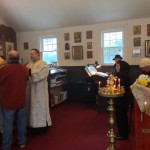
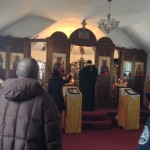
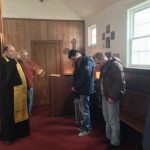
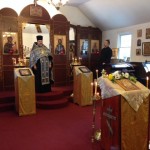
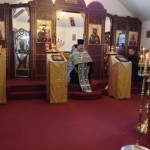
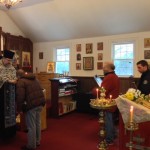
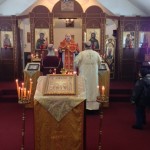
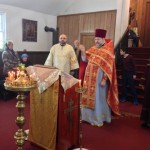
On December 1, on the 23rd Sunday after Pentecost St. George parish had a liturgical celebration in our temple. Our Rector, Archpriest Igor Tarasov served the Divine Liturgy. After the Gospel lesson he preached a sermon:

“Today we began reading the Epistle of St. Paul to the Ephesians. The main theme of this Epistle is to tell about the riches of Christ given in the Church. Thus, in today’s reading we hear the following words: “God who is rich in mercy, because of His great love with which He loved us, even when we were dead in trespasses, made us alive together with Christ” (Eph. 2, 4). It should be noted that if we read the whole chapter, and not just the assigned lesson for today, we would see that these beautiful words are preceded by the word “but”. St. Paul says that the Ephesians once walked according to the course of this world, according to the evil one, conducted themselves in the lusts of flesh; they were by nature children of wrath (Eph. 2, 2-3). “But,” – he says, “God… made us alive” (Eph. 2, 4). “But” is a word which makes a difference.”
“We say, “That is a good idea, but…” “He is a good person, but…” Some of us may be unlucky to hear, “You are a good worker, but I have to let you go”. That word may change the whole situation.”
“This is true in our reading of the Scripture. Again and again we come upon the expression “But God…” Whatever may have been said before is immediately corrected by these words. Today’s Epistle lesson is an example of that. The Ephesians and the whole human kind was living in sin, was driven by the devil, was following the desires of body and mind. But God who is rich in mercy corrected that and made alive those who were dead through trespasses. We had no way to escape the bondage of the devil, the slavery to sin, and the condemnation of death, but God had such a way for us. We were helpless sinners, says St. Paul in another Epistle, to the Romans. Then he says those two words again: “But God shows His own love toward us, in that we were still sinners, Christ died for us” (Rom. 5, 8). No matter how sinful we are, how unworthy or inferior we consider ourselves, God’s forgiving love can hardly wait to bestow upon us the immeasurable riches of His grace. Yes, we are sinful, but God’s mercy is greater than any sin.”
“Let us recall some other examples from the Scripture. The book of Genesis tells us about righteous Joseph, the son of Jacob. He was sold to slavery by his own brothers, then he was brought to Egypt. There he was wrongfully accused and thrown into prison. The Scripture  says, “But the Lord was with Joseph and showed him mercy, and He gave him favor in the sight of the keeper of the prison. And the keeper of the prison committed to Joseph’s hand all the prisoners who were in the prison; whatever they did there, it was his doing. The keeper of the prison did not look into anything that was under Joseph’s authority, because the Lord was with him; and whatever he did, the Lord made it prosper” (Gen. 39, 21-23). It seems that everything was against Joseph, but God was with him. Life does terrible things to us. We suffer broken hopes, moral failures, different misfortunes. But God is able to bring good even out of evil to those who love Him and work with Him. Thus, at the end of the story Joseph said to his brothers, You meant evil against me; but God meant it for good” (Gen. 50, 20).”
“Another example we find in the Gospel. Jesus said to the holy Apostle Peter one day, “Simon, Simon,
behold, Satan demanded to have you that he might sift you like wheat; but I have prayed for you, that your faith may not fail” (Lk. 22, 31). In time of deepest darkness and despair Jesus wanted Peter to know that He cared. He prayed to him to be restored and to become an example of a firm faith to his fellow Apostles.”

“And our final example from the Scripture for today: Jesus on the Cross. He died and then He was buried. That was to be the end of the greatest life ever lived. But wait! Here comes another and the greatest “but” ever spoken “But God raised Him from the dead” (Acts 13, 30).”
“Dear brothers and sisters! The world may press in upon us, but God makes the difference. We are weak, but in Jesus Christ we find strength. We are tempted but in Him we find a way out. We despair, but in Him we find hope. May the Lord God help us to cling to Him!”

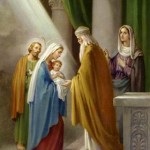
After the Liturgy dismissal Fr. Igor reminded parishioners that on Wednesday, December 4 we will celebrate feast of the Entrance of the Most Holy Mother of God into Temple. He urged to bring children to the church for that celebration, despite it is a school day. For we will commemorate a special event when holy parents Joachim and Anna brought their 3 year old little daughter Mary, the future Mother of the Savior, to the holy Temple in Jerusalem. Classes may be skipped on such days, and parents should not be afraid to write a note to the schools that their children participated in a religious celebration. It is considered a legal absence in the American schools. Parents may think that they do good to their children if they send them to school, but when they do it on the days of great Church celebrations, they harm their kids spiritually. Fr. Igor encouraged parents to raise children in a spiritual and religious way. He recalled an example of the holy Martyr Barul whose memory we celebrate on this very day (Dec. 1). This Saint was martyred along with St. Roman, and he was a young boy. His mother encouraged him to suffer and die for Christ, although he was only a teenager. When the boy, before being killed, asked for a drink, his mother told him to suffer until the end and refused to quench his thirst. Such examples may not be totally understood by many of our today’s parents living by the rules of the world, but they show the greatness of Christian spirit. And all Christian parents are called to do the best for spiritual education of their children.

22nd Sunday after Pentecost


On November 24, on the 22nd Sunday after Pentecost we had the Divine Liturgy celebrated in our church. It was served by St. George’s Rector, Archpriest Igor Tarasov.
Following the Scripture readings Fr. Igor preached a homily:

“On the 22nd Sunday after Pentecost we hear a continuation of the same theme in the Epistle reading as we heard last Sunday. It is about Old Testament rules being abandoned by the followers of the New Testament. Last week we reflected on the words of St. Paul saying that no one can be justified by the works of the Law of Moses, but through faith in Christ. In today’s Epistle lesson St. Paul says, “In Christ Jesus neither circumcision nor uncircumcision avails anything, but a new creation” (Gal. 6, 15). It does not matter whether we follow the Old Testament rules. What matters is whether we are the new creation, new people in Jesus Christ.”
“Thinking of our own life experiences we see that many of us wish to correct our past mistakes. We often wish to change our wrong choices we made in our lives. We would be happy to get a “fresh start”, to have a new beginning, “to start from scratch.” “If only I could begin all over again!” This has been our plea since Adam. Jesus, the Son of God came to us to answer to this plea. He came to give each one of us a fresh start. And He does not require any more to bear a sign of our allegiance to Him on our flesh, as He required the people of the Old Testament. They circumcised their baby boys to show their covenant with God. In Christ this is no longer required. But there are other more important conditions to meet, in order to become that new creation St. Paul speaks of in today’s Epistle.”

“First of all, we have to be born in Christ. Jesus says, “Most assuredly, I say to you, unless one is born again, he cannot see the kingdom of God… unless one is born of water and the Spirit, he cannot enter the kingdom of God” (Jn. 3, 3-5). This new birth is given to us in Baptism. The line of heredity was transferred from the old Adam line to the new Christ line. Life found a new origin, a new beginning. We received the Holy Spirit. Our bodies became temples of God. The blood of Jesus now flows in us through Holy Communion. We became the new creation.”

“But this new birth in Christ must be followed by a personal acceptance of Christ as our Lord and Savior. Many of us were baptized at the early age. But even those who received that Sacrament later in their lives, may lose some freshness of its grace. Thus, after the new birth should come this personal acceptance, personal commitment to Him as God. This is followed by repentance for our sins and a complete forsaking of the old life. It is called conversion. But even repentance itself is called the ‘second Baptism’. We are born again and again in a true repentance, in a sincere and honest confession.”

“A man when he is born is only a man. But a man when he is reborn in Christ is more. He is a new man with a new life and a new name. He is even named after Christ: ‘Christian’.  This new person’s task is to put Christ on, to receive the Holy Spirit through prayer and the Sacraments, so we may conduct that new life in union with Christ and in communion with the Holy Spirit. And that can be done only if we are the members of the Christian community. We cannot be in that alone. “We may be damned alone but we are saved together”, said Alexei Khomiakov, a famous Russian religious philosopher. We are saved in a community which is called the Church of Christ. We Orthodox believe that to be saved it is necessary for every human creature to find fellowship in the Church of Jesus Christ. The Church is the Body of Christ, the Ark of salvation. The Church creates a new man and keeps him alive.”
“Therefore, dear brothers and sisters, let us truly “commit ourselves and each other and our all lives to Christ, our God,” as we pray every Divine Liturgy. Let us receive a new spiritual birth a renewal in the holy Mystery of Penance, to refresh our baptismal grace and ability to be the new people in Christ. Let us participate in the spiritual life of the Christian community, of the Church. Let us be together in this Ark of salvation, a saving Sheepfold. Then we will be able to become this new people of God, a new creation which will be worthy of seeing the Kingdom of God and entering into eternal blessedness!”

Upon the Liturgy dismissal Fr. Igor reminded parishioners that next week, on November 28 the Church enters into the Nativity fast, a period of spiritual preparation to the great feast of the Birth of Christ. This year the first day of the fast falls on the Thanksgiving Day. Therefore, the Rector urged the people of faith to be wise and prudent during that time and try not to break the fast. As one of the ways to avoid this Fr. Igor mentioned a possibility eating turkey earlier in the week.

After the service the Rector and parishioners enjoyed delicious meals and a nice company at the coffee hour.

21st Sunday after Pentecost


On November 17, on the 21st Sunday after Pentecost we had a beautiful celebration at St. George Church. Our Rector, Archpriest Igor Tarasov served the Divine Liturgy. After the reading from the Gospel he preached a homily:

“Today’s reading from the Epistle of St. Paul to the Galatians concerns the idea that a newly converted Christians should not retain the rules prescribed by the Old Testament, by the Law of Moses. Some of the Galatians thought that they should follow the Old Testament regulations and preserve Jewish customs. To persuade the Galatians that those old rules are not in effect for the Christian people, St. Paul wrote, “A man is not justified by the works of the law, but through faith in Jesus Christ” (Gal. 2, 16).”
“Jesus Christ came into this world and brought the New Testament, the new law. This is the law of God’s love. It is based on the old law, because Jesus Himself said that He came not to destroy the Law and the Prophets, but to fulfill them (Mt. 5, 17). For instance, we still have and have to keep Ten Commandments given by God to Moses. However, the Gospel of Christ makes most of the rules of the old law obsolete. God visited His people and offered Himself for them as a sacrifice. Thus the old sacrifices are of no need anymore. God made all things new (Rev. 21, 5).”

“The rules of the Old Testament such as circumcision, observance of Sabbath, dietary restrictions called kosher, all these prescriptions of the Law of Moses had to be abandoned by the new people called Christians. Those rules ceased to mean something important after Christ had come, died for us and was raised from the dead. He fulfilled the Law and the Prophets, therefore, they had to give a way to His new law, the new reality in Christ, in which “neither circumcision nor uncircumcision avails anything, but a new creation” (Gal. 6, 15). This is why St. Paul says that now no man can be justified by the works of the law, but we can be justified only by our faith in Jesus Christ (Gal. 2, 16).”
“People always had certain rules and laws that determine our behavior, shape the way we act and make us do certain things. We know that we have to stop before the red light, we have to pay taxes. Similarly, the laws make us avoid doing certain things. We don’t assault people, don’t steal. There is nothing bad about the laws (at least, about most of them). However, if we observe the law only for the sake of the law, we miss something. If we don’t steal only because there is a law saying that stealing is prohibited and punishable, we miss the most important point. The point is that a good person would not do something because his conscience will not allow him to do so, and not because it is forbidden by the law. The “new creation”, the new people in Christ observe the law because they feel it should be observed. If we have faith in Christ, then it will not allow us to break the law.”

“The Jewish law had many strict observers. In the time of Jesus and the Apostles there was a great number of Jews called Pharisees who meticulously followed the Law of Moses to every least detail. We learn from the Gospel that Jesus often had problems because of these people. He argued with them a lot. The Pharisees picked on Jesus and criticized Him for healing the sick on Sabbath, or for reaping the wheat in the fields on Sabbath when His disciples were hungry. We also recall the parable about a Pharisee and a publican. That Pharisee was proud of himself exactly because he observed the Law. But Jesus pointed out that such an observance did him no good. On the contrary, the publican who was a sinner, who did not follow all the rules of the Law, left the Temple justified. The publican humbly prayed God to be merciful to him; he had a sincere faith, despite his sinfulness. So, “man is not justified by the works of the law, but through faith…””
“We as Christians are supposed to justify ourselves through faith in Jesus Christ. We still have certain religious laws to observe and rules to follow. They are good and important. They help us to find our way to Christ. But they are not the goal of our religious life. We should not observe them only for the sake of those rules. Then we would become like those Pharisees. In our times some Christians are still mistaken about that. Roman Catholics believe that if they observe religious rules and do good works, they receive certain merits, get certain “points” to get to heaven. They think if they collect merits, they can claim salvation. On the other hand, many Protestants think that they don’t need any rules, don’t need to do any works of the law if they believe in Christ. “Believe in Jesus as your personal Savior, and you will be saved!” say many Protestant preachers. Both those communities are in error. They do not understand the teaching of St. Paul. We are justified by faith in Christ, but this faith has to be shown in our works, the works of faith, the works of mercy, the works of the law. Our good deeds and our observance of the Commandments are supposed to be done not because the law says so, and not because we will be rewarded for this or punished if we do not do this.  Our good deeds have to be in our nature as Christians. Doing good things should be like an air we need to breathe. Then we will be justified through faith in Jesus Christ. Such a justification will come not because we do certain things, but because doing them we believe in Christ and strive for the final goal of our existence – to be with Him.”

“Dear brothers and sisters! The law exists to help us. “The Sabbath for made man, and not man for the Sabbath”, said Jesus (Mk. 2, 27). He is the Master of the Sabbath, He is the Giver of the supreme Law. He alone can give a purpose to the laws we follow. Let us believe in Him, follow His commandments and be justified by our faith.”

Following the Divine Liturgy Archpriest Igor Tarasov officiated at the Sacrament of Marriage. Our parishioners Elisej and Anastasia Flora received the Church blessing and were crowned in holy Matrimony. The rite of Crowning was performed very solemnly. Relatives and friends of the groom and bride were present and enjoyed the beauty of our pious liturgical tradition. Upon the dismissal of the office of the Crowning Fr. Igor preached a brief sermon about the meaning of Christian marriage and wished the newlyweds God’s help, divine graces and many happy years.

After the services Elisej and Anastasia were greeted by our parishioners and their relatives and friends. Some refreshments were served and a toast made to the newlyweds.

20th Sunday after Pentecost


On November 10, on the 20th Sunday after Pentecost St. George’s Rector, Archpriest Igor Tarasov served the Divine Liturgy. Following the Scripture readings he preached a homily:

“On the 20th Sunday after Pentecost we begin readings from St. Paul’s Epistle to the Galatians. A few words should be said about this Epistle. Galatians were the people lived in the region in the middle of Asia Minor called Galatia because a couple of centuries before the Galls were exiled there. St. Paul visited that region and converted a number of people. But when he left some of the Galatians began to question his authority and his teaching. This is why Paul had to write an Epistle to them to defend his apostolic authority and to persuade them that he is conveying the right teaching of Jesus Christ. Therefore, in today’s reading we hear his words:  “I make known to you, brethren, that the Gospel which was preached by me is not according to man… but it came through revelation of Jesus Christ” (Gal. 1, 11-12). St. Paul tells that the teaching he received and preached to the Galatians is not man’s invention. It was revealed by Jesus Christ.”
“Christianity is a revealed religion. It was not invented by any wise man, by any philosopher or a religious leader. It came directly from God. Our beliefs, our morals, our values, our guidelines and principles – all were revealed by God through Jesus Christ.”

“Our life is like a traveling in a sea of right and wrong, but God did not leave us without a compass. Any American flight to space could not be accomplished without mission control in Houston. The astronauts were in constant communication with their home base. If they had lost contact, they would have vanished – perhaps forever. If control and guidance are important on a flight to space, how much more important they are for our journey through this life to eternity. Yet the good news is that God has not left us alone on this journey. He has given us guidance. He gave us His Son, Jesus to be our “mission control”. In constant contact with Him, guided and filled with the Holy Spirit, we know the way, we know what the real values of life are.”
“Many today’s people and even today’s Christians are confused and disoriented. This is why we see them accepting wrong ideas and wrong values of this world. This happens because they lose the contact with our “mission control”, with our Lord Jesus Christ and are deprived of the grace of God. On the other hand, a true Christian person should feel like being out of step with the values of this world. It is because he marches to the music of a different drummer: the Lord Jesus. He is the One Who reveals to us values that never change, the eternal value of God. As He Himself said, “I am the Way, the Truth, and the Life; no man comes to the Father except through Me” (Jn. 14, 6).”

“A diamond assessor has a difficult job to determine the value of different finished diamonds. He is surrounded by dozens of trays of those precious stones. One day an assessor was asked how can he look all day at hundreds of diamonds without becoming confused. The assessor smiled. “It is very simple,” he replied. Holding out his hand, he pointed to a fabulous diamond ring on his finger. “This diamond is perfect,” he said. “It doesn’t have a single flaw. Every half hour or so, I put it under my eyeglasses. The picture of the perfect diamond restores my sense of values!””
“What the flawless diamond was to the assessor, the Lord Jesus is to us. By looking constantly at Him and measuring all things in the light of His perfection and His commandments, we keep a sense of what is really important and what is not, what is right and what is wrong, what is eternal and what is temporal, what is expensive and what is cheap, what deserves our allegiance and what does not.”

“Dear brothers and sisters in Christ! Our religion and our way of life are not based on the opinions of great thinkers or human leaders. They are based on the will of God revealed to us. God has spoken in Christ. He was the One Who spoke to St. Paul. He is the One Who speaks to us today. Let us listen to Him. Let us obey the voice of God said at the Transfiguration on Mt. Tabor, “He (Jesus) is My beloved Son, listen to Him!””

After the Liturgy Rector and parishioners enjoyed refreshments and a nice company at our coffee hour.

19th Sunday after Pentecost


On November 3, on the 19th Sunday after Pentecost we had our liturgical celebration at St. George Church. The parish Rector, Archpriest Igor Tarasov served the Divine Liturgy. Following the Gospel lesson he preached a sermon:
“In today’s Epistle lesson we are told strange words that St. Paul says the Lord Himself told him: “My grace is sufficient for you, for My strength is made perfect in weakness” (2 Cor. 12, 9). This is a paradox of our Christian faith: strength is made perfect in weakness.”
“We have to say that Christianity is full of paradoxes, of certain contradictions. We believe in God Who is ineffable, inconceivable and incomprehensible, yet we believe that we may know Him. We say that God does not belong to the world, yet He is present everywhere in the world. We believe that God is Spirit, yet He became man. We believe that God is strange to our nature, yet He acquired our own nature. We believe that God is inapproachable by men, yet we may become the partakers of His nature. In the same way St. Paul tells us that the Lord says that our strength is made perfect in our weakness.”

“When we are weak, then we are strong. This is so because our weakness makes us lean on God’s strength. There is a story of a sheep that limped and never went away from the shepherd. Someone asked about this sheep – why it limped and why it never left the shepherd’s side. The shepherd explained that that sheep was partially deaf and could not hear the shepherd’s voice. As a result, it was often in danger. Many times it had to be rescued. Finally the shepherd had to injure the sheep’s leg. Since then the sheep limped, but it stayed closer to the shepherd and it was safe. The sheep was weak, but it was strong along with the shepherd.”
“In today’s Epistle reading St. Paul tells that he was also afflicted by some “limp”. It did not come from God, but from the evil one. Paul says that he was given “a thorn in flesh, a messenger of Satan to buffet me” (2 Cor. 12, 7). Many interpreters of the Scripture guessed what kind of “thorn on flesh” St. Paul had. It could be a chronic illness, or troublesome Christians who criticized him, or hard-hearted Israelites who persecuted him, or even some sinful desire which burned St. Paul, tempted his flesh. We don’t know for sure. But what we do know is that God allowed that thorn to remain in order to keep Paul weak, “limping” at the Shepherd’s side where he would find constant strength for his weakness. And when St. Paul discovered that the true purpose of that thorn was to keep him close to the Source of power, he rejoiced. He said, “Therefore, most gladly I will rather boast in my infirmities, that the power of Christ may rest upon me” (2 Cor. 12, 9).”

“All of us, at least once in our lives, were driven into a corner from which there seemed to be no way out. If this happened, you may be sure that God allowed it, so He may come with His almighty power to deliver you. But first He wants you to discover that you are powerless and that you have to depend on Him. “When I am weak then I am strong.” If we are weak, let us admit it and accept it. Let us not pretend that we are able to do a lot of things. Accept the weakness, but not just the weakness. Accept that such feeling of weakness is needed to lead us to Him Who is the real source of strength.”
“Some young man once said to a priest, “Don’t you see, your religion is a crutch!” The priest replied, “Sure it is. But who is not limping?” Like the sheep in the story, we have to limp by the Shepherd’s side. St. Paul did and became strong.”

“St. Paul prayed three times that the thorn in flesh, his weakness might depart from him. God answered him and said, “My grace is sufficient for you…” (2 Cor. 12, 9). To all our weaknesses God may give us His help which will be enough to overcome the difficulties, to solve the problems and to feel secure. And God said to Paul that His power is made perfect in weakness. Paul discovered that God is right. In his weakness Paul leaned on Christ and found power beyond what he thought possible.”
“Let us then, dear brothers and sisters, ask our Lord that our weaknesses may drive us closer to Him and that we may find in Him the strength to follow Jesus on the path of our salvation. Let us then boast in our infirmities, that the power of Christ may rest upon us!”

Upon the Liturgy dismissal Fr. Igor reminded the parishioners of the feasts celebrated during the following week, especially the solemnity of the Icon of our Lady of Kazan on November 4th. This feast is now a national holiday in Russia because the miraculous icon of Kazan at least two times saved that country from the foreign enemies, especially in 1612 when it helped the people to free Moscow from the invaders.

18th Sunday after Pentecost


On October 27, on the 18th Sunday after Pentecost St. George Parish family had a nice celebration. This time it combined several festive occasions.
At the Divine Liturgy served by our Rector, Archpriest Igor Tarasov we celebrated Sunday resurrection joy and honored the Holy Fathers of the 7th Ecumenical Council of Nicaea. After the Scripture readings Fr. Igor preached a homily interpreting the Epistle lesson:
“The first Epistle lesson for today is about giving. St. Paul teaches the Corinthians saying, “Let each one give as he purposes in his heart…” (2 Cor. 9, 7). Thus, today we will talk about the way we should give to the Church and how St. Paul instructs us to give.”

Speaking of giving leads us to talk about money. We all heard a saying, “Money talks”. This words are sometimes true, and not always in a negative sense. For instance, the way we spend our money will say a lot about us, about our preferences. If a biographer wanted to write a book about you, he would want to review your old financial records, for instance, your old checks. They could tell him what kind of person you are. He could find out that you are a member of the church. But suppose that in looking through your checks and other records he learned what your income is, and discovered that in a typical year you spend one percent of your income for God’s work and ten percent for your personal luxuries. Then he would probably be justified to write that you loved the Lord in the amount of 1 dollar per week and loved your personal luxuries in the amount of 10 dollars per week. Money talks! It tells what kind of people we are, what we value most in life, what we love and care for most.”
“Our church giving is very often much less than our spending for our different needs. This is why it is important to understand that our giving has to be proportionate to what we have. The important thing in Christian giving is not “how much” we give, but “how much in comparison to our ability”. A gift does not need to be large in order to be significant. It is great or small in proportion to the amount of other things we possess. One of the greatest examples of Christian giving is the poor widow who came in to the Temple one day and gave “all that she had”. It was not very much, just two copper coins, but the Lord said about her, “Assuredly, I say to you that this poor widow has put in more than all of those who have given to the treasury; for they all put in out of their abundance, she out of her poverty put in all that she had, her whole livelihood” (Mk. 12, 43-44).”

“Dear brothers and sisters, let us give proportionately as God blessed us. And let us give lovingly. The Christian giving is a personal commitment to Christ. Therefore, if you don’t love God, don’t give. God does not need a support from those who do not really care. But if you do care about the Church, about God’s work, let your giving be some indication of your love.”

“Give proportionately, give lovingly, give generously. St. Paul says, “He who saws sparingly will also reap sparingly, and he who saws bountifully will also reap bountifully” (2 Cor. 9, 6). When it comes to giving to God and His work, if you must make a mistake, make it on the side of generosity, as you would if you loved one were in need and asked you for something. Make a mistake on the side of going beyond what is practical and try what is spiritual. Then if you saw bountifully, you will reap bountifully. Give abundantly and you will receive abundantly.”

“Today’s final advice of St. Paul to us is to give gladly. He says, “Let each one give… not grudgingly or of necessity; for God loves a cheerful giver” (2 Cor. 9, 7). Give from your heart, give cheerfully. Even a dog knows the difference between reluctant and cheerful giving. Throw him a bone and he will go away without wagging his tail. But call him kindly, pat him and then give him a bone, and he will go away with a wagging tail. In both cases it is the same act of giving a bone. But the way, the spirit of giving makes a difference.”

“Dear brothers and sisters! Let us then ask ourselves how do we give to God? Do we give proportionately? Do we give to Him lovingly, generously, gladly? Do we give Him not only our money but also our energy, our talents, our abilities, our time, our very lives? If our giving to God is proportionate, loving, generous and cheerful, then God, as St. Paul teaches us, will provide for us with His blessings. St. Paul assures us that we will be “enriched in everything… which causes thanksgiving through us to God” (2 Cor. 9, 11). If our giving is abundant, God’s giving to us will be even more abundant.”

At the end of the Liturgy Fr. Igor reminded parishioners that on October 27 the Church commemorates Venerable mother Paraskeva, a Saint very much honored in the Balkan countries, as well as in Moldova and Western Ukraine. One of our parishioners and our altar server, Elisej Flora today celebrates his home, or family Patronal feast. It is a Serbian tradition to celebrate feast of a family Patron Saint (called “Slava”). Ven. Parakeva is Elisej’s family Patron Saint. On that occasion Fr. Igor congratulated Elisej Flora and his wife Anastasia and wished them God’s blessings, intercession of Ven. Paraskeva and many happy years. The choir sung traditional Polychronion (“Mnogaya leta”).
Fr. Igor also congratulated our guest Paraskeva who celebrated her name day, and proclaimed the singing of Polychronion for her.

Following the Liturgy the Rector headed the rite of “Slava” for Elisej and Anastasia Flora. He blessed and symbolically cut the offered bread (“kolach”) pouring wine on it. Hymns in honor of St. Paraskeva were sung. Fr. Igor congratulated the Flora family again.

After all our services Rector and parishioners joined at the table for a celebration of today’s festivities. We enjoyed a warm company and delicious meals, as well as congratulated the people who celebrated their family and personal feast in honor of St. Paraskeva.
Holy Mother Paraskeva, pray for us!


17th Sunday after Pentecost


On October 20, on the 17th Sunday after Pentecost we had a service in our temple. St. George’s Rector, Archpriest Igor Tarasov celebrated the Divine Liturgy. Following the reading from the Gospel he preached a homily:
“Today we heard the words of St. Paul recalling God’s promises to the people. The Apostle recites the words of the Lord said to Moses: “I will dwell in them and walk among them. I will be their God, and they shall be My people” (Lev. 26, 12; 2 Cor. 2, 16). These promises were given by God Himself to His chosen people of Israel. St. Paul assures that the same promises are now given to us, the New Israel, the members of the Christian Church.”
“In our times we do not like to believe the promises given to us by other people. A famous senator said to his son, “Son, there are two qualities that will get you far in government: integrity and astuteness. By integrity I mean if you ever give your word, keep it. By astuteness, I mean don’t ever be stupid enough to give your word.”

“God both gives His word and keeps it. Some famous Orthodox preacher gives us a very modern and American example: a bank check. A check is a man’s promise to pay. It depends totally upon the person who signs it, upon his integrity, his word. When you have confidence in a man, you take his check as readily as cash. Then you endorse it. But if you refuse or forget to endorse it, it becomes just a piece of paper.”
“The Scripture is full of the great promises made by God. They are backed by God’s name, God’s integrity, God’s tremendous powers. Each one of these promises is for you. They are like checks made out to you bearing God’s signature. All that is required that you have enough faith in the signer to endorse the check, and to receive what is promised.”

“It is about these promises St. Paul speaks in today’s Epistle lesson when he says, “Therefore, having these promises, beloved, let us cleanse ourselves from all filthiness of the flesh and spirit, perfecting holiness in the fear of God” (2 Cor. 7, 1).”
“There are many false promises being made today by politicians. Recent economic crisis and other financial problems in the country and in the world show us that false promises are made by financial institutions. And we always knew that it is not wise to trust the fantastic claims made by the advertising industry. But these false promises make us not trusting to all other promises, especially to the one miraculous claim which happens to be gloriously true. That claim is that Jesus Christ saved us.”

“If we read the Scripture, we may see how the Lord fulfills His promises. In the Old Testament God promises to send His Savior. He says that the Messiah is to come of the family of David. The genealogy written in the first chapter of the Gospel of Matthew lists the fulfillment of this promise. The promise was that the Messiah would be born of a Virgin Mother. He was! The promise was that He will be born in Bethlehem, in Judea. He was! The promise was that He will be betrayed and sold for the thirty pieces of silver. He was! The promise was that He will die and that His side would be pierced. It was! And, finally, the promise was that Christ will be raised from the dead. He was! Therefore, St. Paul says, “All the promises of God in Him are Yes, and in Him Amen…” (2 Cor. 1, 20).”
“Understanding how true are the promises of God, let us also remember that for every promise there is a condition. St. Paul says that having such promises, “Let us cleanse ourselves from all filthiness of the flesh and spirit, perfecting holiness in the fear of God” (2 Cor. 7, 1). In order to see the fulfillment of God’s promises in our lives, we have to strive for perfection. God promised us salvation, but the condition for us is to believe in Him. The promise of God is to forgive us, but the condition is to repent and to forsake our sin. The promise is to give us whatever we ask, but the condition is that we should abide in the Lord. Thus, the fulfillment of God’s best promises depends on conditions: abiding in Christ, living with Him, surrendering to Him. God wishes to be our Savior, but He saves us only if we participate, if we work with Him. Recalling the example of a check, let us accept and endorse the ‘check’ given to us. Our works of faith and perseverance will be rewarded by the fulfillment of God’s promises.”

After the Liturgy we had our coffee hour and enjoyed delicious refreshments and a good company.

16th Sunday after Pentecost


On October 13, on the 16th Sunday after Pentecost we had a celebration at our temple. St. George’s Rector, Archpriest Igor Tarasov served the Divine Liturgy. Following the Scripture readings he preached a sermon:
“In today’s Epistle lesson St. Paul makes an interesting statement. He says, “Behold, now is the accepted time; behold, now is the day of salvation” (2 Cor. 6, 2). In this way the Apostle urges his listeners to act upon their salvation, to receive the grace of God and to keep it, not to receive it in vain (2 Cor. 6, 1). In other words, we have to do the important things now, not some day.”

“Many people endure the present while they are waiting for something better to occur in the future. They believe that now they are doing some small things, but later their fate will open the door to something more important and significant… Some woman said, “I am living for that blessed day when my children grow up, my husband retires and I will get a little rest”. When her husband retired and the children were married and living in their own homes, this same woman was very unhappy person. She looked back to the time when her husband was working and the house was full of children as the happiest time of her life.”
“How often we miss the joy and the happiness of the present time because we keep thinking how much better it will be tomorrow. Thus, St. Paul reminds us, “Now is the accepted time, now is the day of salvation” Now, not tomorrow, is the time to live, to be saved, to be made whole.

“Our time on earth is limited. Every moment is unique and unrepeatable. Tomorrow is not ours; today is. Now is the time to do the works of mercy. Now is the time to say a prayer. Now is the time to pronounce the words of forgiveness. Now is the time to repent if we have sinned. Now – before our time runs out. Now is the most glorious period of life. God’s time is always now. “Now is the accepted time…””.
“This is why, dear brothers and sisters, we should not postpone our spiritual works, our prayers, our reception of the Sacraments, our acts of mercy and charity, our forgiveness and reconciliation with our brethren.”

“If a gambler says: “I must quit gambling. Tonight I am going to do it the last time, but tomorrow I will stop”. Such a gambler will never stop. But if he says, “I must quit gambling. I cannot speak for tomorrow, but as for today I am not gambling” Such a person will quit. If we postpone our action until tomorrow, this tomorrow may never arrive. Only ‘today’ is real.”
“There is a legend according to which Satan once called the demons to seek out a way to keep people away from God. One demon said, “Let’s tell people that there is no God”. Another said, “Let’s tell that God doesn’t care about right and wrong”. Finally, the third devil said, “Let them believe that there is God who cares about right and wrong. But let’s just keep whispering that there is no hurry”. And the demons agreed that this is the best way of eluding people. And Satan has been whispering to us, “Yes, of course, you must do all good things, but you don’t need to do them today. There is no hurry. Take your time and do it when you are ready.” In this way Satan is tempting us and keeps us from achieving most of good things we want and intend to do. This is the way the evil one is stopping us from receiving the grace, or makes us receive it in vain… Finally, when we approach the end of our lives, we realize, after it is too late, that we have achieved only a tiny portion of our potential, that we have done only a small bit of the good we intended to do.”

“How often we hear people say, “I wish I had time for church, for prayer, for the Bible”. We do have time! God gives it to us. Each morning, 24 hours are presented to us. We must never be too busy to sit at Jesus” feet, nor too preoccupied to go out and serve Him. Because there will come a time at the Judgment seat of Christ when we shall have to give an account of what we did with all our days and hours, which can never be repeated.”
After the Liturgy dismissal Fr. Igor reminded parishioners in English and in Russian language that on this day the Church commemorates two holy men who were the first bishops of the two local Churches: St. Gregory the Enlightener of Armenia and St. Michael, the first Metropolitan of Kiev. Both became the first heads of the local Christian Churches, Armenian and Russian. The history showed how things can change. The Armenian Church which once was the Church of the first Christian nation in the world history, separated from the universal Orthodoxy. But the Russian Church preserved Holy Orthodox faith. This also proves St. Paul to be right when he says, “Behold, now is the accepted time; behold, now is the day of salvation” (2 Cor. 6, 2). We have to do the right thing at each moment in our life, in our history. We have to keep fidelity to the Holy Orthodox Church like those two Saints whom we honor today.

15th Sunday after Pentecost


On October 6th, on the 15th Sunday after Pentecost, we had our services at St. George Church. Our Rector, Archpriest Igor Tarasov celebrated the Divine Liturgy.
After the Scripture reading Fr. Igor preached a homily:
“Reading the Epistles of St. Paul we always learn about Christian life. We discover what it means to be a Christian. On the last two Sundays we were reflecting upon the notion of being a new creation in Christ, being crucified to the world and that Christ should live in us. Today’s Epistle lesson is telling us some other interesting aspects of Christian life.”

“St. Paul says that through Jesus Christ God let His light shine in the hearts of men (2 Cor. 4, 6). This is a special ability, a special gift from God. His light may shine in our hearts, Jesus can live within us, the divine grace is given to us. But, as St. Paul goes further, “we have this treasure in earthen vessels” (2 Cor. 4, 7). ‘Earthen vessels’ mean vessels of clay, clay jars. That means that we are earthly people, we have our material bodies which are subject to corruption and death. We cannot live this earthly life forever. Our bodies are like clay jars which may be easily broken. In addition, our souls are also corrupt by sin and attached to our bodies and our earthly desires. They are also vulnerable like those earthen vessels. The treasure of divine grace is held in us like in earthen vessels.”
“St. Paul tells us that entrusting such a gift to the earthen vessels is necessary. He says that “we have this treasure in earthen vessels, that the excellence of the power may be of God and not of us” (2 Cor. 4, 7). We should realize our infirmity and our imperfection, to be humble. We should not become too proud and should understand that our faith and the grace are coming from God, and not from our own merits.”

“Living like those earthen vessels make our life difficult. It is even more difficult to live a true Christian life. But if we think about it, we may realize that God never permits us to be annihilated, to be totally destroyed and to be tempted more than we can endure. Therefore St. Paul says, “We are hard pressed on every side, yet not crushed; we are perplexed, but not in despair; persecuted, but not forsaken; struck down, but not destroyed…” (2 Cor. 4, 8-9). The Apostle goes further and says that “the life of Jesus also may be manifested in our mortal flesh”. He says that although death is working in us, life also works (2 Cor. 4, 11-12). Commenting on those words St. John Chrysostom wrote that these trials mentioned by the Apostle show both the power of God and, more, disclose His grace. Christian life is a victorious one, but not trouble free. We need to endure all kinds of trials in order to become worthy of our Lord who also underwent sufferings but became the Conqueror of death.”
“At the end, as St. Paul reminds us, “He who raised up the Lord Jesus will also raise us up with Jesus, and will present us” (2 Cor. 6, 14). Our earthly lives will end, our earthen vessels will be destroyed, but God will restore both our lives and our bodies at the end of time, so we can be presented at the second coming of His Son. Our trials and troubles, if we suffered them as true Christians, will not be in vain. We will be living eternal life. We will no longer have the treasure held in earthen vessels but in the vessels which will last forever.”

“Therefore, dear brothers and sisters, let us be humble and appreciate that God entrusted His treasure, His divine gifts, to be held in our earthen vessels. Let us endure and persevere in our trials, tribulations and temptations of this life. Let us keep in mind that at the end God who raised Jesus from the dead will also raise us up, so we may be given life eternal.”
At the end of the Liturgy Fr. Igor greeted our parishioner and Parish Treasurer Vera Koretz on her past Name day (September 30th) and wished her God’s blessings and intercession of her heavenly patron, Holy Martyr Vera (Faith). The choir sung “Mnogaya leta”.

After that greeting our Warden Olga Roussanow congratulated the Rector on his past Name day, commemoration of St. Igor of Chernogov (October 2nd), wishing Fr. Igor God’s help in his service to the Holy Church and St. George Parish, a spiritual joy and success. The choir sung “Mnogaya leta” to our Rector.
Following the services all joined at our delicious trapeza and could again congratulate Fr. Igor and Vera.

Sunday after the Exaltation


On September 29th, on the Sunday after the Exaltation of the Cross, Archpriest Igor Tarasov celebrated Divine Liturgy at St. George Church. Following the reading from the Gospel he preached a homily:
“On the Sunday after the feast of the Exaltation of the Cross we again are given a special set of readings from the Scripture. Today’s Epistle is telling us again about the meaning of being crucified with Christ. St. Paul says, “I have been crucified with Christ…” (Gal. 2, 20).  It does not mean that St. Paul became physically crucified on the cross as Jesus. It means that his sinful passions and desires have been crucified. It is a crucifixion of his flesh, of the fallen and corrupt nature. It is a life in faith, not in flesh. And as St. Paul teaches, the result of such a crucifixion is that Christ lives in us.”
St. Paul utters, “It is no longer I who live, but Christ lives in me” (Gal. 2, 20). If we live by faith in Jesus Christ, it is no longer we live under the dominion of sinful passions, but under the power of Christ. The grace of God is penetrating our nature, thus Jesus Christ lives in us.

There is a story about a monk who knocked on the door of heaven seeking entrance. A voice asked, “Who are you?” The monk replied, “It is I”. The door did not open. After many years he tried again. As he knocked, the same voice asked again, “Who are you?” “It is I”, answered the monk. The door remained closed. Finally, he came back after many years. The monk became older and wiser as a Christian. When the same voice asked him, “Who are you?” the monk replied, “You in me”. And the voice said, “Come in”.
“If we ask who is a good Christian, we may have many answers. We may say that it is a person who is baptized, who believes in Jesus Christ, who goes to the church, who receives the Sacraments, and so on. This is true. However, these answers are not complete because they do not say the most important thing about a Christian: he is one in whom Christ lives. “You in me!” “It is no longer I who lives, but Christ lives in me”. Our Lord expresses this when He said to His disciples, “I am the true Vine, you are the branches. He who abides in Me, and I in him, bears much fruit; for without Me you can do nothing” (Jn. 15, 5).

“These words of Christ telling that without Him we cannot do anything, remind us that our Christian religion is not just doing the works of a certain religious law. St. Paul warns the Galatians in today’s Epistle that “a man is not justified by the works of the law but by faith in Jesus Christ “(Gal. 2, 16). Our works according to the law of God cannot save us if we do it without a living faith in Christ, without Jesus living within us. On the other hand, our faith alone also cannot save us if we do not live according to that faith. The Jews thought they can be justified only by living by the law of Moses, and the Protestants tend to think that they can be saved only by confessing faith in Jesus Christ. They both are mistaken. We can be saved by faith and by the works according to our faith. If Christ lives in us, we have faith and we deal according to it.”
“People living in Christ are shining by His light. They look like a home, a palace which becomes illuminated when its master is hosting a royal family. If only a few people are home, just a small light filters through the windows. When friends come, many lamps are lit and the palace becomes beautiful. But when the royal family is visiting, the entire palace becomes illuminated. Some people may be described in that way. They have a shining personality, so seeing them you can say that they entertain a Royal Guest”

“We should say that we are no palaces, but temples of the living God. When the Royal Guest is present within, He gives us joy, peace, love and light to our lives. Especially it happens when we worthily receive this Guest in the holy Communion. For He said, “He who eats My flesh and drinks My blood abides in Me, and I in him” (Jn. 6, 56). But that reception has to be proper and worthy, otherwise Christ will come but will not stay. Let us try to live a Christian life, to crucify our flesh with its sinful passions and desires and to abide in Christ, so we may also be able to say, “It is no longer I who live, but Christ lives in me”!”
Following the Liturgy Rector and parishioners venerated the Precious Cross.

After the service we had our coffee hour with delicious refreshments.