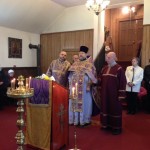
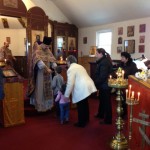
Circumcision of the Lord. Feast of St. Basil the Great


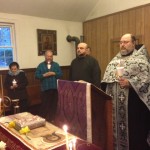
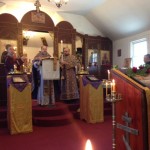
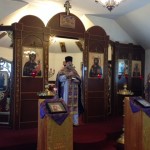
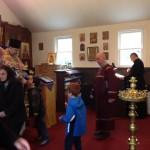
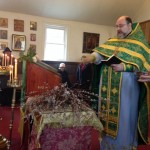
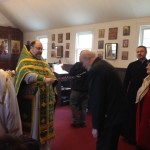
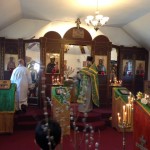
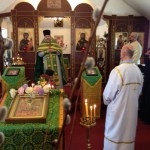
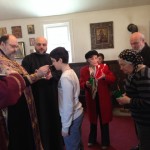
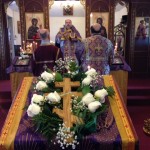
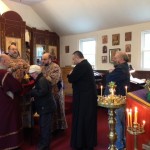
On January 14 the Church celebrates two important holy days: Circumcision of the Lord and memory of St. Basil the Great. In addition, this day used to be civil New Year’s Day in the countries adhering to the old calendar. On this solemn occasion we had a liturgical celebration in St. George Church. Our Rector, Archpriest Igor Tarasov served the Divine Liturgy. Following the Gospel lessons Fr. Igor preached a sermon. He pointed out that we celebrate two feasts and also have Scripture readings assigned for the Sunday before Theophany because this year such a Sunday is missing. He then continued and said:

“In today’s first Epistle lesson St. Paul tells his disciple Timothy that his life comes to an end. Using a beautiful and poetic language he says, “I am already being poured out as a drink offering, and the time of my departure is at hand” (2 Tim. 4, 6).”
“Celebrating the beginning of the New Year we may come to think about our life. We may wonder how fast the time flies and reflect upon our life, upon its meaning and purpose. Thinking of that we may recall that many philosophers viewed human life as being empty and meaningless. They could call it “a pilgrimage from nowhere to nowhere”, an “illusion”, a “hollow bubble” and so on. But these were the thinkers who did not really believe in God. In contrast to them, the words of St. Paul in today’s lesson sound very refreshing and inspiring, “I have fought a good fight, I have finished the race, I have kept the faith. Finally, there is laid up for me the crown of righteousness” (2 Tim. 4, 7-8). St. Paul viewed his life as a “good fight”, a “race” for which he will be given a reward. To him the meaning of life was found. He realized it when he encountered Christ. After we meet Jesus, we know that the life has a plot. It leads somewhere. It has a purpose. It can result in a peace that passes all understanding. To exist is the part of every person, but life in all its fullness belongs only to those who have been united to Christ. Without Christ life is hopeless end; with Christ it is endless hope.”
“Today’s another Epistle lesson confirms that when we hear St. Paul warning against anyone who could cheat us “through philosophy and empty deceit, according to the tradition of men, according to the principles of the world, and not according to Christ” (Col. 2, 8). He reminds us that in Jesus Christ “dwells all the fullness of the Godhead bodily”, and that we become complete only in Him (Col. 2, 9). Speaking of the rite of circumcision St. Paul assures his listeners that in Christ we receive spiritual circumcision which is holy Baptism. Thus we have no need of bodily circumcision prescribed by the Old Testament law. Our Lord Jesus Christ whose Circumcision we commemorate today, allowed it to happen to His flesh in order to fulfill the Law of Moses and in order to show that He submits Himself to the rules existing among men. But His future followers became freed from such an obligation because they became “circumcised with the circumcision made without hands, by putting off the body of the sins of the flesh, by the circumcision of Christ, buried with Him in Baptism” (Col. 2, 11-12). If in the Old Testament circumcision rite only a small piece of flesh was removed, in the circumcision of Christ, in our Baptism, the whole flesh is supposed to be removed in a spiritual way. In Baptism we die to the flesh and live to God.”

“Becoming complete in Christ, we see the purpose of our life. Without Christ nothing in our life seems to have a purpose. Nothing fits. But if Jesus in our life is for real, everything fits, everything has meaning. If we need Christ and wish to live our lives with Him, we see that. And we seek some order to be introduced in our lives. This was very much understood by the Saint whose memory we celebrate today. St. Basil the Great all his life dedicated to the service of the Church, to the writings about God and to the summarizing rules of the Church life. Thanks to his labors we now have a great number of rules and canons which regulate our spiritual behavior and govern our Church discipline. Life had a meaning to St. Basil. And he lived it accordingly. He used the precious gift of time given to him to fulfill his works on earth. This time was short. But it was used abundantly. This is why when the holy hierarch passed from this life, another holy bishop said at his funeral, “Everything was good about you, o Basil; the only thing was bad, too short was time of you being a bishop in Caesarea”.”
“Dear brothers and sisters! Let us seek and find the meaning and purpose of our life in Christ Jesus. In Him we may fight a good fight, we may win a good race and being spiritually circumcised in Him, we may receive the crown of righteousness prepared for those “who have loved His appearing” (2 Tim. 2, 8).”

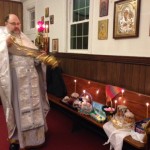
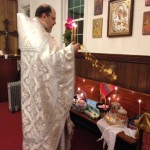
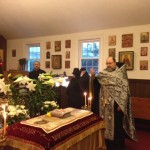
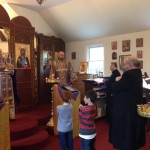
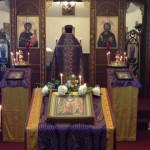
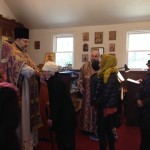
After the Liturgy dismissal the Rector and the altar servers came before the icon stand and performed the rite of glorification singing the troparia and kontakia of both feasts, as well as the magnification of St. Basil. After celebration Fr. Igor congratulated the parishioners on the occasion of the feast.    

Sunday after the Nativity


On January 12, on Sunday after the Nativity, St. George Church’s Rector, Archpriest Igor Tarasov served the Divine Liturgy in our temple. Following the Gospel lesson he preached a homily. Fr. Igor began his preaching by mentioning that Sunday after Christmas is dedicated to honor some holy people who were close to our Lord Jesus Christ as members of His human family, related to Him by human blood. One of them is St. Joseph the Spouse of the Blessed Virgin Mary who was the head of the household to which both Child Jesus and His Holy Mother belonged. Joseph was Jesus’ legal father, the head of the Holy Family. Another person whom we commemorate on this Sunday is holy king David, an ancestor of the Most Holy Mother of God. Finally, we honor holy Apostle James, the brother of the Lord who was the Joseph’s son and thus he was a stepbrother of Jesus.

Fr. Igor continued saying:
“The Epistle lesson assigned for today is from the beginning of the Galatians. In this reading St. Paul is defending his apostleship and telling about his way to become an Apostle of Christ. We all remember that St. Paul was not among the twelve Apostles, he was not following Christ during the time of the Lord’s ministry. However, just as the twelve Apostles were directly called by Christ, so was Paul although this happened much later in time. And just as the twelve Disciples received the Gospel directly from Christ, so did Paul. Therefore, in today’s reading he is confirming that the Gospel which was preached by him is not according to man, for, as he says, “I neither received it from man, nor was I taught it, but it came through the revelation of Jesus Christ” (Gal. 1, 12).”
“Again we have to remind ourselves that Christianity is a revealed religion. Everything we believe in and adhere to was revealed by God to the certain people. Then these certain people told the others about it. In the Old Testament times God spoke thorough Moses and the Prophets. The Scripture is full of the examples of how God reveals His will to the righteous ones. For instance, today’s Gospel story is telling us how the Angel of the Lord appeared to Joseph in a dream and guided him to save the life of the Child Jesus. Although the Gospel is a New Testament Scripture, this story repeats the Old Testament experience of the holy people being guided by God.”

“But things changed. After God took our flesh, He began to speak not only through the Angels but also by Himself. And as St. Paul says, then God “has spoken to us by His Son, whom He has appointed heir of all things, through whom also He made the worlds” (Heb. 1, 2). After His Resurrection and Ascension into heaven, the Good News of Jesus Christ was then entrusted to the holy Apostles who preached it to the nations. This Gospel is not man’s invention, but the Word of God. This is why St. Paul warns the Galatians not to accept any false and perverted ‘gospel’. In the beginning of the same chapter the passage of which we heard today, St. Paul says, “Even if we, or an Angel from heaven, preach any other gospel to you than we have preached to you, let him be accursed” (Gal. 1, 8).”
“In our modern times we still see many false teachers and false preachers who attempt to pervert the true Gospel and to preach us their own invention. For instance, some of the modern thinkers support the idea of surrogate motherhood. They base their opinion on the examples from the Old Testament where some children in the families of the righteous people were born not of their mothers, but of the other women, for instance, of the servants. However, those biblical cases are no examples of surrogate motherhood. In those cases children born of the servant women were never considered being children of the wives. They were recognized by the fathers, but not taken from their biological mothers. What we see in surrogate motherhood is that the children are separated from the women who give them birth. Therefore, people defending surrogacy, in fact, preach their own ‘bible’, a false and perverted ‘gospel’ willing to please men but not God.”

“Dear brothers and sisters! We possess a great and the most valuable treasure, the true Gospel revealed by Jesus Christ. It is manifested in our true Christian, Orthodox faith. Our faith is that valuable treasure. It is preached to us through God’s revelation. Revelation has two sources – Holy Scripture and Holy Tradition. Everything written in the Scripture or held by our pious Tradition is not from men, but is given to us by God. The Lord entrusted to us this precious gift of faith. In a similar way God entrusted His only-begotten Son when this Son of God became a little Child, to the care of righteous Joseph. Every Christian should imitate Joseph, imitate his obedience to the will of God, his loving care of the holy Family and his courage in following the God’s commands. As St. Joseph protected the Child Jesus from Herod, we have to protect our faith from different modern Herods. As St. Joseph saved the Child Jesus from being slaughtered, so we have to save our faith from being annihilated by different false religions. As St. Joseph took care of the holy Family, we have to take a good care of our churches, our parishes. And, finally, as St. Joseph preserved Jesus for the future appearance to the mankind, so we have to preserve our pious traditions for future generations. If we do so, then as St. Joseph, we will be blessed and receive eternal award in the Kingdom of our Lord Jesus Christ.”

Upon the Liturgy dismissal Fr. Igor congratulated our parishioner and altar server Joseph Kay on the occasion of his name day, wishing him God’s blessings and intercession of St. Joseph. The Rector then proclaimed traditional polychronion (“Mnogaia leta”) to be sung.

After the liturgical service the Rector and parishioners gathered at the table to enjoy delicious refreshments at the coffee hour.
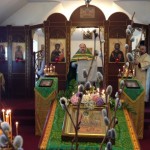


Christmas


On January 7, on the feast of the Nativity of the Lord (Christmas) we had a beautiful liturgical celebration in St. George Church. Our Rector, Archpriest Igor Tarasov served the Divine Liturgy.

Following the Scripture readings Fr. Igor proclaimed the Catechetical sermon of St. John Chrysostom on the Nativity.
After the Divine Liturgy the Rector congratulated all parishioners on the occasion of the glorious holy day and wished them that God’s blessings may be bestowed on them in their spiritual and earthly lives.

Celebration was continued at the nearby Pier 25A restaurant. Parishioners had an opportunity to congratulate Fr. Igor on the occasion of the 24th Anniversary of his priestly ordination. One of our altar servers, Elisej Flora had a speech greeting Fr. Igor. Traditional “Mnogaia leta” was sung.

Sunday before the Nativity


On January 5, on Sunday before the Nativity, St. George’s Rector, Archpriest Igor Tarasov celebrated the Divine Liturgy in our temple. After the reading from the Holy Gospel he preached a homily.

In his sermon Fr. Igor was pointing out the importance of faith which was indicated to be the main cause of the endeavors of the holy men and women of the times before Christ, as St. Paul says in his Epistle reading assigned for today.
“How amazing this thing called faith. For example, how amazing that the shepherds, when the heavens were opened and the Angels sang, could have believed that the Savior was born in Bethlehem and would be found in a cave among animals. How amazing! How it is unbelievable! They should have said, “How can this be? Why should God open the heavens so that Angels should sing to lowly shepherds? Surely, if God had an announcement to make, He would make it to the king or to the high priest, not to us”. How astonishing that the shepherds believed that they would find God’s Son being born not in a palace, but in a stable! Yet they believed.”
“How amazing that the Wise Men believed when they came to Jerusalem and found no festivities for the birth of a prince. All was still. The Wise Men might well have gone home. Instead, they inquired and searched the Scriptures, and did not hesitate to go to tiny Bethlehem. How amazing that they should believe that the Prince of Peace, the Savior of the world, the promised Messiah, would be born in a backwoods village instead of at Rome or Athens! Yet they believed!”

Speaking and explaining how we can define faith Fr. Igor compared faith to one of our senses. “Faith is the eye by which we look to Jesus; the hand by which we lay hold of Jesus; the mouth or the tongue by which we taste how good the Lord is; the foot by which we go to Jesus”.

Fr. Igor concluded his homily saying, “If you believe that there is no one at the helm of this universe, that you are just flying endlessly through space, then you have a right to be angry, to go crazy and to end it all. But if you have faith and believe that there is Someone in charge of the universe; that that Someone is the God who ‘so loved the world that He gave His only Son, so that whoever believes in Him might not perish but have life everlasting,” then you, too, like Gideon and countless others mentioned in today’s Epistle lesson, can conquer kingdoms.”

Following the Liturgy dismissal the Rector reminded of the approaching holy day of the Nativity of the Lord and wished that everyone can appropriately prepare for the celebration of the Birth of Christ.

Sunday of the holy Forefathers


On December 29, on the Sunday of the holy Forefathers, St. George Parish family had a nice liturgical celebration. Our Rector, Archpriest Igor Tarasov served the Divine Liturgy. Following the Scripture readings he preached a sermon:

“For today’s Sunday the Church assigns a reading from the Epistle of St. Paul to the Colossians. All the righteous men of the Old Testament whom we call the holy Forefathers awaited the appearance of the Messiah and He did appear to the world in Jesus Christ. In a similar way we, Christians, should be righteous and expect the second coming of Christ. St. Paul says that when Christ appears, we also will appear with Him in glory (Col. 3, 4). If we will strive for righteousness, we will be able to share the glory of the Lord. We have to seek true life in Christ, awaiting the heavenly and glorious revelation, expecting His second coming.”
“To be successful in living true life in Christ we need to put to death what is earthly or sinful in us. St. Paul says in today’s Epistle, “Put to death your members which are on the earth: fornication, uncleanness, passion, evil desire, and covetousness, which is idolatry” (Col. 3, 5). Holy Forefathers achieved righteousness by avoiding idolatry in a literal sense, being faithful to one true God and not serving false gods. If it was enough for them, our task is more demanding. We need to avoid a more sophisticated idolatry, serving the false gods of our passions. One step to achieve this was made when we received holy Baptism. In Baptism we are supposed to die spiritually with Christ, we have to put to death the man of old in ourselves. In his another Epistle St. Paul teaches: “Do you not know that as many of us were baptized into Christ Jesus were baptized into His death? Therefore, we were buried with Him through Baptism into death, that just as Christ was raised from the dead by the glory of the Father, even so we also should walk in newness of life” (Rom. 6, 3-4). After we put to death a man of old, after we put off the old Adam we have to be reborn with Christ to a new life with Him. Thus, we may say that we died with Christ in Baptism. Our sins were drowned and we rose to a new life.”
“Another step to achieve righteousness in Christ is to put to death what is earthly in us. Since we are baptized and put off the old Adam nature and have put on the new Christ nature, we have to die to what is earthly. This has to be done every day. Some people may think that true Christian life is having peace. No, it is a constant struggle. True Christian life demands continuous warfare against the enemies of that life. We have to put to death what is earthly in us. One of the desert fathers said, “If you say that you have died to the world, don’t be so confident until you depart from your body. You may say, ‘I have died’; but Satan has not died”. Thus, every day we have to fight against our temptations, sinful desires and inclinations. Every day we are called to die to unbelief, to our fears and uncertainties that we may rise to confidence, courage and trust. In this way we die to the old nature that we may rise with Christ as new persons.”

“Finally, we all know that some day we will have to die physically. We Christians should view it not as a final point of our existence, but as a passing to a new life. We should notice that living is a matter of life and death. As we go through life we die and live again many times. The infant dies for a child to live. The child dies to make way for the teenager. The teenager dies so the adult can emerge. And so into old age, we go constantly from life to death. Part of me is dying every moment. Moment by moment cells in my body are dying and being replaced with new ones. If it did not happen, I would not be alive. As St. Paul says, “I die daily” (1 Cor. 15, 31). But we do not consider such death really fatal. Same should be considered about our physical death. It is rather a change, a passing to another stage of our existence.”
“Dear brothers and sisters, today we see that there are three kinds of dying for righteous people. First is to die with Christ in Baptism, so we can rise and live with Him forever. Second is to die with Christ every day to what is earthly and sinful in us. Third is to die one day a physical death. But if we have died the first two deaths, then the third death, the physical one, will not be a death, but a resurrection. Thus it was to the Christian Martyrs and Confessors. Thus it should be to us, so when Jesus Christ, our Life appears, we may also appear with Him in glory! (Col. 3, 4).”


26th Sunday after Pentecost


On December 22, on the 26th Sunday after Pentecost, St. George Church held a liturgical celebration. The Divine Liturgy was served by the parish Rector, Archpriest Igor Tarasov. After the reading from the Gospel he preached a homily:

“Today is December 22, and this is the shortest day of the year. Last night was the longest night, but starting tomorrow the days little by little will get longer. Natural darkness will be overcome by light. In today’s Epistle lesson St. Paul also talks about the light and darkness, but in a spiritual sense.”
“Today’s Epistle reading to the Ephesians has many beautiful thoughts and instructions for us. Every phrase, every sentence of today’s reading is precious. But the main idea of St. Paul’s message was to remind his spiritual children that they have to spend their life wisely, doing things which are really important and necessary for salvation. The main thought is to tell us that we have a precious gift of time, and our time must be filled with rather spiritual, not worldly preoccupation. St. Paul calls it “to walk as children of light” (Eph. 5, 8). What a nice expression! We say that Jesus Christ is our Light, so we are His children, “children of Light”. Our journey of this life has to be “walking as children of light”. St. Paul shows the contrast between light and darkness, day and night. For him life without remembering of God, without faith in Jesus Christ was like walking in the darkness. And, on the contrary, since Christ is our Light, living with Him is walking in the light. But in order to walk in the light, as St. Paul tells us, we have to find out “what is acceptable to the Lord” (Eph. 5, 10). It means that we have to learn what is right and what is wrong, what is good and evil, eternal or temporary. It is about choosing what is best for us. And it is about establishing the priorities.”
“Today’s Epistle lesson becomes especially useful if we remember that we are in the middle of the Nativity Fast, if we recall that we should be preparing ourselves for Christmas. Here we are confronted with many visible features of this world, the world which often lives without remembering of God. All those commercials, advertisements dedicated to Christmas, all that rush with buying presents, going shopping and preparing for the holiday season, – all of that very rarely reminds us of the true meaning of Christmas. This kind of preparation may not be wrong by itself, but it is not going to get us far in our spiritual life. We have to remember about priorities. And the priority is to prepare for the Nativity by spiritual works, by prayer, fasting, and repentance. This is why the Church established this period called St. Philip’s Fast to help us in that preparation. This is the right time “to walk as children of light” and to walk carefully, as St. Paul instructs us, saying, “Walk circumspectly, not as fools but as wise, redeeming the time, because the days are evil. Therefore, do not be unwise, but understand what the will of the Lord is” (Eph. 15-17). I think that this is an excellent instruction!”

“When I served at one of my former parishes I once had a conversation with a woman, a parishioner of mine. She had certain disability and was not able to attend the church. I asked her whether she wants me to visit her during the Nativity Fast, so she could receive the Sacraments before Christmas. The woman answered that she is too busy preparing for the holidays. She said that she has to prepare the pirohy for Christmas Eve supper. The time the conversation occurred was three weeks before Christmas. Three weeks before the holy day, and this woman is saying that she has to spend most of her time making pirohy! Is Christmas about the pirohy or any other food? Was Christ born and came to this world, so we can make pirohy? Is it all He wants from us: the Christmas tree, decorations, lights, presents? Or maybe we should distinguish what is really important, necessary, and what is of the less importance. Having a traditional Christmas Eve supper with all those twelve meals is very nice. It is great, but it is much less important than having a pure heart, clean soul and joyful spirit. And Christmas shopping, certainly, is much less important than spending your time in prayer, in spiritual expectation of our Lord coming to us, in repentance for our sins, in going to confession. Believe me, staying and waiting in the line for confession is much more helpful and fruitful than spending your time in the line at the shopping center!”
“Going to confession before Christmas is spiritually fruitful. And St. Paul mentions today the word “unfruitful”. He urges us to “have no fellowship with the unfruitful works of darkness” (Eph. 5, 11). Time is precious, and we have to spend it fruitfully. Many worries, cares and preoccupations of this world are, in fact, unfruitful.  And especially fruitless are the works of sin and dark desires of our corrupted nature. Why should we waste our time having fellowship with them?”

“Dear brothers and sisters! The message of today’s Epistle lesson is in the words of St. Paul who calls us, “Awake, you who sleep, arise from the dead, and Christ will give you light” (Eph. 5, 14). When we care about less important things, when we spend our time doing less important tasks, we are in the spiritual darkness, we are spiritually asleep, even dead. Let us awake, especially now, during this blessed time of Fast, let us walk in the light, let us walk “circumspectly”, not as fools, let us understand what the Lord’s will is for us. His will is that we remember that there is God who cares, who loves and who gave His only Son for us. This Son of God we should be expecting now, when we prepare for the holy days. This Son of God we should be expecting any day of our life. Thus, let us be awake and expecting!”

After the dismissal of the Liturgy Fr. Igor had a brief sermon about the feast of the Conception of the righteous Anna that we celebrate on December 22. He mentioned that Roman Catholics developed an elaborated teaching about the Immaculate Conception of Mary which they would celebrate today, if they were following our calendar. We, Orthodox Christians, do not share that Catholic belief not because we do not consider Virgin Mary sinless and immaculate, but because we strongly believe that Her freedom from sin was not a result of being “programmed” in the beginning, at the moment of Her Conception. It was a result of Her personal choice to serve the Lord and not to commit any sin. Of course, Virgin Mary was abundantly blessed by God’s grace to make such a choice. But the choice was Hers. And it was finally made when She responded to Angel Gabriel saying, “Behold, I am the servant of the Lord” (Lk. 1, 38). And today’s feast celebrated on the shortest day of the year when the light will soon begin to overcome darkness in the earthly nature, this feast reminds us of the Conception of Mary, the Theotokos who began Her life today. Later She was born, grew up and then She gave birth to the Son of God who overcame the darkness of this world.

Following the service our parishioners and the Rector enjoyed delicious meals and a good conversation at the coffee hour.
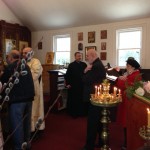
Patronal feast at St. Nicholas Cathedral


On December 19, on the feast of the Holy Father among the Saints, Nicholas the Wonderworker our Patriarchal Cathedral in New York celebrated its Patronal feast. The Divine Liturgy at St. Nicholas was celebrated by His Eminence, Archbishop Justinian. Our Rector, Archpriest Igor Tarasov joined the Archbishop and other clergy and concelebrated the service. Celebration was also attended by our Warden and Choir Director Olga Roussanow and our parishioner Moses Dunetz.

Following the Divine Liturgy our Rector and parishioners attended festal luncheon held at the Cathedral hall.


25th Sunday after Pentecost


On December 15, on the 25th Sunday after Pentecost St. George Church’s Rector, Archpriest Igor Tarasov celebrated the Divine Liturgy in our temple. After the Gospel reading he preached a homily:

“The message of today’s St. Paul’s Epistle lesson is about unity. St. Paul is writing to the Ephesians and all early Christians that they should live “endeavoring to keep the unity of the Spirit in the bond of peace” (Eph. 4, 3). He explains this unity saying that “there is one body and one Spirit… one Lord, one faith, one baptism; one God and Father for all” (Eph. 4, 4-6). So, today we will reflect on the unity. It is very important to be united. Perhaps every nation has proverbs, sayings or parables about the importance of unity. If a nation is united, it can overcome any powerful enemy. If a family is united, it can survive any crisis. Unity is an indispensible condition for a group of people to achieve success.”
“However, if we look at the way we, people, live and relate to each other, we may realize that unity is very desirable, but not often an existing thing. People are divided in many ways. They are conservative or liberal, Republicans and Democrats, pro-life and pro-choice, Christians and Jews, believers and atheists. To make the issue trivial, let us recall that we have different taste. People like different food or different colors. People have differences. We are different in many ways. And in many instances it is totally appropriate to be different, to hold a distinct opinion or to like what somebody else does not like. God created us to be different, to be individual persons. But in some cases people need to be united. In some instances differences become very dangerous, if not fatal. If a boat is sinking, everyone should work together in order to be saved, cooperate with the captain and not express the differences. In such a situation differences in opinion as to what should be done may cost people lives.”
“This is the case when people are bound together in striving to achieve the goal of eternal salvation. Such a group of people is a community of believers called the Church. The Church has to be one, all members should be united by one goal, one way of life, one spirit. Although we are many different persons with many different thoughts, opinions and preferences, we have to share one nature in Christ. As St. Paul believes, this is a new nature uniting Christian community, so it has “one body and one spirit, one Lord, one faith, one baptism” (Eph. 4, 4-6). We have one God in whom we believe, one and only Savior, Jesus Christ whom St. Paul calls “one Lord”. In Baptism we all become able to partake of the same nature. We also become the followers of one teaching, and as St. Paul put it, “called in one hope” (Eph. 4, 4). These are the things in which we may not have differences. These are the points about which we may not argue. It would be improper or dangerous to argue about that. Therefore, St. Paul warned his spiritual children that they have to preserve unity in faith.”

“Speaking of these signs of unity St. Paul reveals us a mysterious reality of life of the Holy Trinity in the Church. He tells us about one God, one Lord and one Spirit, the Three divine Persons of the Trinity, God the Father, Son and Holy Spirit. He also combines one Baptism and the three virtues of faith, hope and love into one great reality. Each Person of the Trinity sanctifies us, but the sanctification is one, because our Baptism is one, and the grace of that Sacrament is one.”
“Therefore, dear brothers and sisters, we need to preserve the unity of faith. We cannot divide the body of Christ, the Church. We cannot separate ourselves from it. But there may be a question how this unity should appear. St. Paul describes it very briefly is “the unity of the Spirit in the bond of peace” (Eph. 4, 3). Should it be then a uniform group of people with the same views, customs and habits? Or, on the contrary, should it be a unity in diversity where each person or each particular group has certain distinctive features? Should it be a “melting pot” or a beautiful mosaic? This country, the United States, was first tending to be a melting pot for the nationalities joining here together, but later it began to consider itself rather a beautiful mosaic consisting of different ethnic and religious groups with their different customs, cultures and traditions. This kind of unity gives strength to this nation.”
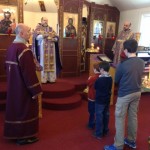
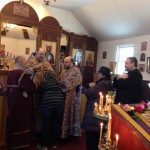
“Same kind of unity should be preserved in the Church of Christ. Resembling the mysterious unity of the Three Persons in the Holy Trinity, the Church has different traditions, customs of the different nationalities that all united in the same Universal Church. We have such differences between the Greek and Russian Church. We have also some distinctions between each ethnic Orthodox community, between the Russians, Serbs, Romanians and so on. But all of us united in the same faith, same Baptism, same hope to achieve salvation. Some people may visit a Greek parish and say, “Oh, they pray, sing and serve differently. There is something wrong with them!” These people would be mistaken. The Greeks are of the same Orthodox faith as we are. Even in the same national Church there may be some slight differences between one parish and another. And again, some people may go to another parish and say that there is something wrong there. They are mistaken. The Church is not a melting pot. It is a unity in diversity.”
“Therefore, dear brothers and sisters in Christ, let us not forget one hope of our calling (Eph. 4, 4). Let us keep the unity of one faith, hope and love, the unity in one Spirit, one Lord and one Baptism, in “one God and Father of all, who is above all, and through all” (Eph. 4, 6).”

After the Liturgy dismissal Fr. Igor congratulated our parishioner and sacristan, Andrew Malyshew on the occasion of his past name day and wished him God’s blessings and many happy years. A traditional polychronion (“Mnogaia leta”) was sung.

The Rector also said a brief sermon about the feasts of the coming week, especially about St. Nicholas Day (December 19). He also reminded of the days of commemoration of the Old Testament Prophets during this time of the Nativity fast. Fr. Igor called the parishioners to spend this season of fasting reading the Scripture, especially the books of the Old Testament prophecies about coming of the Messiah into the world. That coming was prophesized in those books and we now spiritually expect to celebrate it on Christmas.

24th Sunday after Pentecost


On December 8, on the 24th Sunday after Pentecost we had a celebration in our temple. The Rector of St. George Church, Archpriest Igor Tarasov served the Divine Liturgy. Following the Gospel reading he preached a sermon:

“In today’s Epistle lesson St. Paul is talking about us, Christian people, as about some kind of building. He says that we are “built on the foundation of the Apostles and Prophets, Jesus Christ Himself being the chief cornerstone in whom the whole building being fitted together, grows into a holy temple in the Lord…” (Eph. 2, 20-21). These words and these beautiful examples St. Paul used to convince the early Christians that all of them, both Jews and Gentiles, all those who converted to Christ, became united in Him as parts of one building. Both circumcised and uncircumcised, became fitted together in one community established by God.”
“We should admit that St. Paul is also talking about us. In Christ each one of us becomes the temple of the Holy Spirit. Recently we celebrated feast of the Entrance of the Most Holy Mother of God into Temple. The Blessed Virgin Mary entered the holy Temple in Jerusalem. But in our prayers we say that Mary Herself was a Temple because She had to bear the Son of God. God found Himself a dwelling within Her. But also from the moment Virgin Mary entered the Temple of Jerusalem, the Holy of Holies, Her human life itself became a Temple. Later every follower of Christ became a temple, because God dwells within us by His grace and because we are united with Him as members of His Body.”
“That understanding leads us to another idea that St. Paul conveys in today’s Epistle lesson. He is talking about the spiritual building of the Body of Christ, of the Church. We, as its members, are built on the foundation of the Prophets and Apostles, and the cornerstone of the building is Jesus Christ Himself. In Him, says St. Paul, the whole building is fitted together (Eph. 2, 21). Thus, we are parts of the building which is the Church. We are the members of the greater Body which belongs to Jesus Himself. We are also members of God’s household, as St. Paul nicely put it in today’s lesson. He says, “You are no longer strangers and foreigners, but fellow citizens with the Saints and members of the household of God” (Eph. 2, 19). If you really think about this, you may realize what a great thing it is! Some people dream of being members of a wealthy and influential family, some people wish they were born to rich and noble parents. Here we are, all of us, born to the family of Christ, members of God’s household! What family can be more powerful, what household can be wealthier?! We are the parts of Christ.”

“This kind of honor requires a lot of responsibility. That means, we have to be aware of the great role which is given to us. If God wishes to permeate all our life, we must be aware of that and cooperate with His grace in all moments of our existence.”
“One Christian preacher said once, “The real test of religion is life. To know whom you worship, let me see you in your shop, let me overhear you in your trade; let me know how you rent your houses, how you get your money, how you keep it, or how you spend… The test of your religion is your weekday life, your works, and not your words.” He was right although he wasn’t Orthodox. He was right because we need to practice religion not only by what we do in church, but also by what we do out of church: how we speak, how we earn money, how we treat our family. Of course, the Church is necessary. Here we meet Christ, here we are able to receive Him in the Eucharist. But in another way we meet Him also outside of church in everyone, even in least of our brethren. In the temple we receive Christ, but we need to bring Him out of the temple, into the world to reshape the world according to Christ.”

“Dear brothers and sisters! If we are members of God’s household, parts of the Body of Christ, and temples of the Holy Spirit, let us bring the Triune God to others. Our stay in the holy temple is like staying on Mt. Tabor. But Jesus did not heed the request of Peter to remain on the mountain. He descended into the valley to continue His ministry. Therefore, the purpose of our ascension through prayer and the Liturgy in the temple is that we may be transfigured with Christ and then descend from our ‘Temple mountain’ into the valley of life to transfigure it with His grace and love.”

Since on this day the Church observed final day of the celebration (apodosis) of the Entrance of the Most Holy Mother of God, upon the Liturgy dismissal the Rector and altar servers performed the rite of glorification in front of the festal icon. They sang the troparion, kontakion and magnification of the feast.

After the service Fr. Igor had a brief speech reminding the parishioners that on December 8 we commemorate Holy Hieromartyr Clement, pope of Rome. This Saint who was one of the Apostolic men, one of the first bishops of Rome, is dear to us, members of the Russian Church because he was exiled to Crimea and martyred there. Later his relics were miraculously uncovered there. At the same place in Crimea our enlightener, great prince Vladimir received holy Baptism. Our local Church of Rus’ has its beginnings there. Therefore, St. Clement being a Roman and the bishop of Western Church, was in fact a Saint of the Universal Church who is so dear to us, the Russian Orthodox.

Following our services parishioners enjoyed the coffee hour having delicious refreshments and a nice conversation.

Entrance of the Most Holy Mother of God into Temple


On December 4 the Church celebrates feast of the Entrance of the Most Holy Mother of God into Temple. We had a nice celebration at St. George Church. Our Rector, Archpriest Igor Tarasov served the Divine Liturgy. Following the Scripture readings he preached a homily:

“The Entry into the Temple of the Most Holy Mother of God happened, according to the preserved accounts of Holy Tradition, in the following manner. The parents of the Virgin Mary, righteous Joachim and Anna brought their little daughter Mary to the Temple when She was 3 years old.  Then the high-priest, through an inspiration from above, led the Most Holy Virgin into the Holy of Holies. It was a special place in the Temple, separated by the veil where only the high-priest could enter one time a year with a purifying sacrifice of blood. Therefore, all those present in the Temple were astonished at this most unusual occurrence…”
“The meaning of this holy day for us is very profound. Today we hear the Troparion of this feast saying that we celebrate a “preview, or prelude of the goodwill of God”. The Entrance of the Theotokos into the Holy of Holies is a preview of what was intended by God to happen to the human kind. Not Blessed Mother, but Her Son, the Lord Jesus Christ entered the Holy of the Holies to offer a sacrifice for the whole humanity. Due to that sacrifice of His blood shed on the Cross, we became saved. And coming of the Blessed Virgin into the Temple, Her ascending on the steps leading to it, it is a sign, a preview of our universal ascending to the countenance of God.”
“The Prophet, holy king David  foresaw this and exclaimed, The virgins, her companions who follow her, shall be brought to You, with gladness and rejoicing they shall be brought; they shall enter the King’s palace”(Ps. 44, 15). Those virgins, the companions of the Theotokos are the souls of the faithful. The King’s palace is God’s heavenly abode. It is the task for our souls to follow the Blessed Virgin, to be Her companions.”
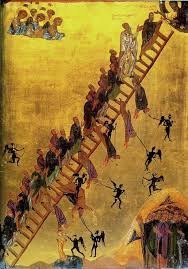
“The tradition tells us that the little girl Mary ascended to the Temple through the steps. There were 15 those steps. In the same way, our souls may have many steps to climb into the heavenly glory, up to the holiness. St. Theophan the Recluse, a great Russian spiritual writer,  named three major and most important steps for our souls to follow the Theotokos.”

“St. Theophan says that the first step is to chose virtue instead of sin, to chose good over evil. It is already difficult because our corrupted souls like to live according to the desires of flesh. Our flesh enslaves the soul, and the soul lives pleasing the flesh. For instance, it is easier to eat everything than to keep fast. It is easier to indulge yourself than to persevere. If we firmly chose virtue and pious life over a life of sin, then we make the fist step.”|
“The second step is to act in piety not just superficially, but through all our mind and through all our heart. Some people appear to be good, pious or caring, but they do it because it makes them look good, because it helps them in life or makes them successful. For instance, some workers do good work because they want to be paid well and to be promoted, not because they feel they should be good workers. All our essence should desire to be good in our hearts and works, to be pious before the Lord and to be caring for the neighbor.”

“Finally, the third step is to live with God, to feel His presence, “to walk before God”, as the Scripture says. This is the goal of the soul. Two previous steps are just preparing for that. This is to enter through the veil, to enter into the Holy of Holies, to be in front of God’s countenance. Some holy people became worthy of such a state. They were able to reach that final step even during their earthly life. Thus, this is possible for us.”
“These are the three steps to follow the Most Holy Mother of God in Her Entrance. On which step is our soul? Let us remember that any one of those three steps is good. What is not good if we are under them, if we lay in sin and chose sin instead of climbing those steps. Thus, dear brothers and sisters, like those virgins, the companions of the Blessed Virgin, let us follow Her on the steps to the entrance into the King’s holy palace, into the heavenly abode of the Almighty God!”

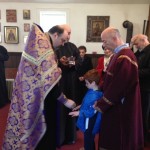
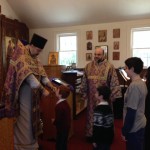
After the Liturgy dismissal the Rector and the altar servers came before the icon of the feast and performed the rite of glorification singing the troparion, kontakion and magnification of the Entrance. After celebration Fr. Igor congratulated the parishioners on the occasion of the feast and expressed his joy of seeing children in the temple.